


Favors never become change requests
The ask arrives in a demo, a Slack thread, or a call, and filing a change request for "two hours" feels disproportionate, so the work simply enters the sprint, unscoped and unpriced.
Use Case · Margin Protection
Surface unscoped work within days, not weeks: how agencies stop delivering “small favors” for free and start pricing them before the invoice.
The sprint demo goes well: the dashboard lands, the client is pleased, and the room settles into the easy mood that follows good news. That is usually the moment it begins.
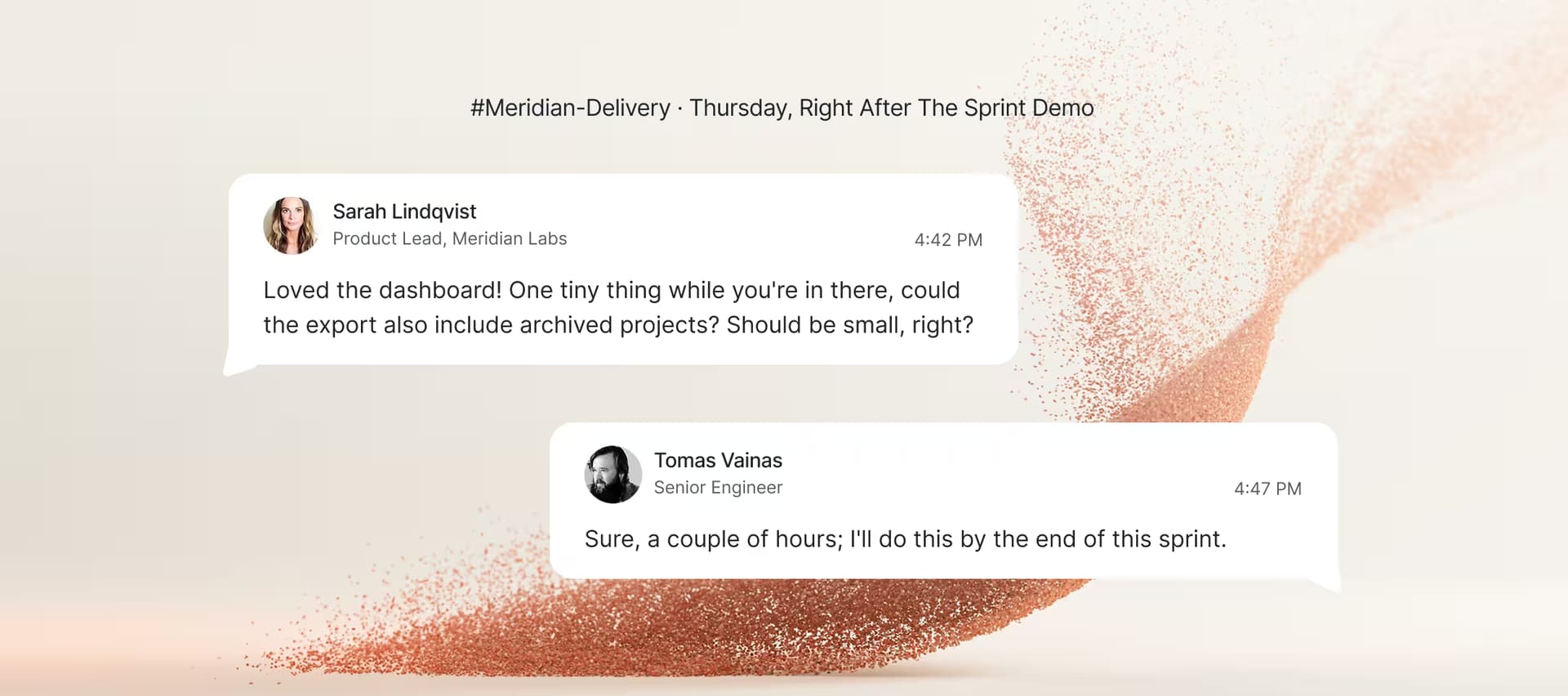
No change request is filed, and it is easy to see why: for two hours of work, the paperwork feels heavier than the favor, and the relationship outweighs the formality.
What no one sees yet is that the export touches the archive schema, which in turn touches the permissions layer, so two hours quietly become nine. The following week brings two more small requests, a filter tweak and a report column; the week after, three. Each is minor enough that nobody escalates it, each is logged honestly, and none of it is billed to anyone.
Eight weeks later, the project is 70% over its estimate, and nobody can pinpoint where the hours went, because they went everywhere, two hours at a time.
Scope creep often stays unnoticed because margin-eroding work is indistinguishable from the work that earns it: the same tickets, the same commits, the same standups. A capable team and a reasonable client can watch it happen and still miss it, because nothing about it announces itself.
Which is why the same pattern repeats on almost every project:
The ask arrives in a demo, a Slack thread, or a call, and filing a change request for "two hours" feels disproportionate, so the work simply enters the sprint, unscoped and unpriced.
Every individual task looks fine, so the status stays green; velocity dips slightly and completion slips slightly, but nothing crosses anyone's mental threshold until the overrun is already structural.
The conversation that should have happened at hour two arrives at invoice time instead, by which point it has stopped being a question of scope and become a dispute over cost, so the agency discounts, takes the loss, and moves on.
The Hidden Сost of Manual Reporting
27–45%
Typical overrun on fixed-price projects affected by scope creep
PMI Pulse of the Profession8 wk
Average lag between scope creep starting and being detected
Tolmete customer baselineUp to $90K*
Average margin an agency can protect per year with Tolmete
Tolmete ROI estimateThe usual response is to add more control: stricter change requests, longer status meetings, and weekly scope reviews. In practice, that still leaves the agency relying on busy people to notice small changes while the project is already moving.
Tolmete changes where the pattern becomes visible. It works from the project records your team already creates: time logs, task movement, Activity Tags, scope baselines, and delivery context from connected tools. As unscoped work begins to build, it compares that activity with the agreed scope and surfaces a signal for the PM to review.
The signal gives the PM a clear basis for action: what changed, when the pattern appeared, how confident the system is, and what the potential billing exposure looks like relative to the project rate card.
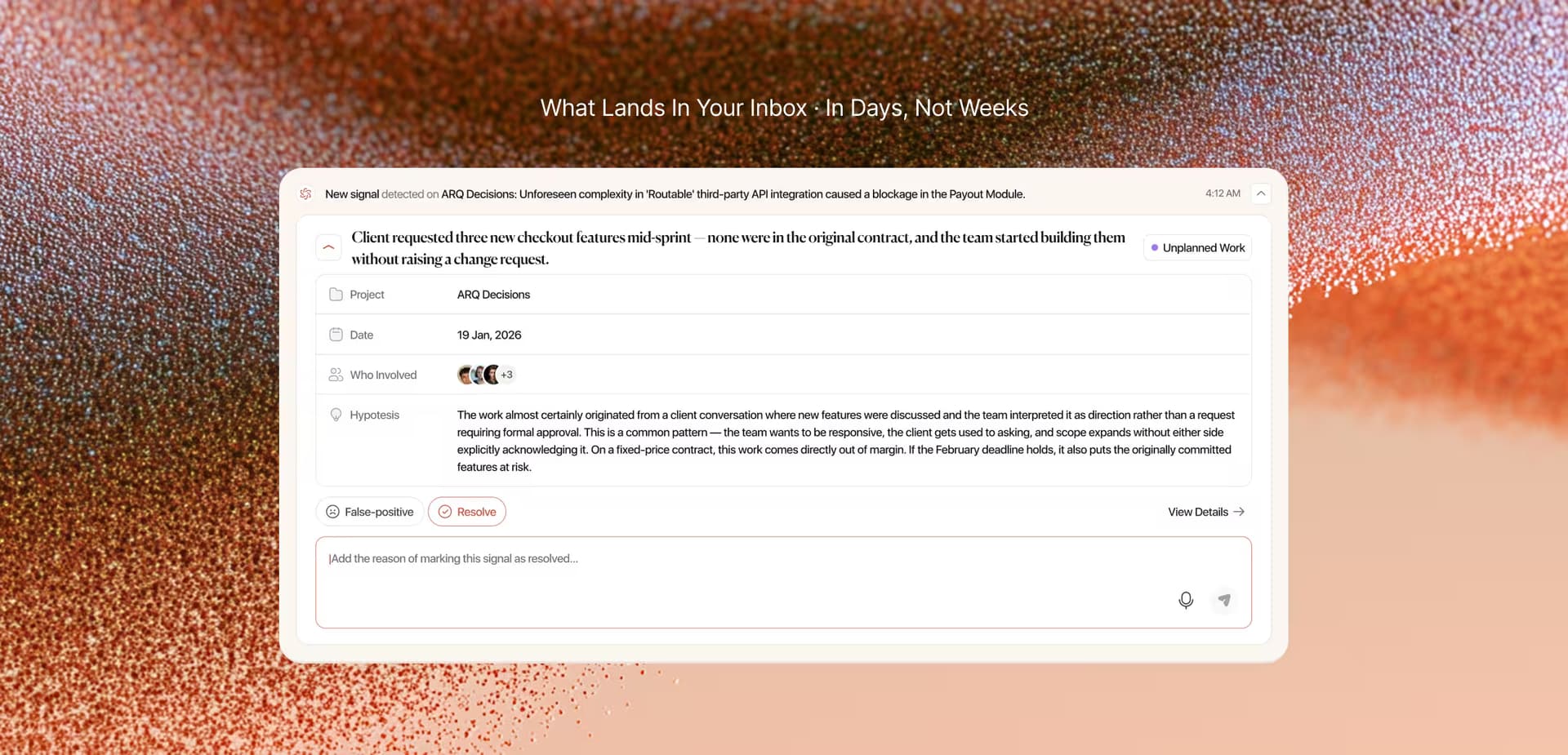
Tolmete works without a new reporting layer, using the records already produced during delivery and turning them into a clear basis for action when work begins to move beyond the agreed scope.
It uses structured records from connected tools, including time logs, task movement, Activity Tags, scope baselines, and project context. The team keeps working as usual, without maintaining a separate reporting workflow.
It checks whether new effort fits the sprint plan, project scope, and commercial agreement. Work that stays within the plan remains part of normal delivery, while work that begins to move outside the agreed scope contributes to a signal.
When the threshold is reached, the signal shows the scope movement, confidence level, and estimated billing exposure based on the agency's rate card. The PM can see whether the issue needs a quick note, a change request, or a client conversation.
Each signal includes a suggested action, such as raising a change request, re-baselining a forecast, or reviewing the scope with the client before the issue reaches invoicing.
The AI Chat Assistant powers several workflows across Tolmete and works as an AI workflow assistant for teams that want less friction in daily operations.
Avg detection after setup: typically within days of the first unscoped hour.
$-impact computed from your own rates.
Connect
Jira, GitHub, Slack · ~3 min per tool
Tune
scope threshold + your rate card
Detect
Scope creep, within days
Tolmete helps keep the relationship generous without letting extra work disappear into the project. Engineers can maintain momentum, PMs can see when effort starts to move beyond scope, and clients still get the responsive partner they chose. The difference is simple: additional work becomes a clear change request while it is still easy to discuss.
Portfolio margin visibility before risk reaches the client.
A live burn picture instead of a month-old spreadsheet.
Clear change requests mid-project, without an end-of-project standoff.
Back to that Thursday afternoon. The demo has gone well, the client is happy with the dashboard, and the request about archived projects still sounds reasonable. Tomas says yes, and that instinct is not the problem. A responsive team should be able to help without turning every small ask into a negotiation.
What changes is what happens next. By Saturday morning, the archive export has already taken nine hours across the schema and permissions layer, and Tolmete raises a signal. The PM is not discovering the pattern eight weeks later, when the margin is already gone. She is looking at one request, two days old, with the effort and billing exposure attached.
That makes the conversation easier because everyone still remembers the ask, and the work is still close to when it was added to the sprint.
Fourteen hours are billed instead of written off. There is no defensiveness and no dispute.
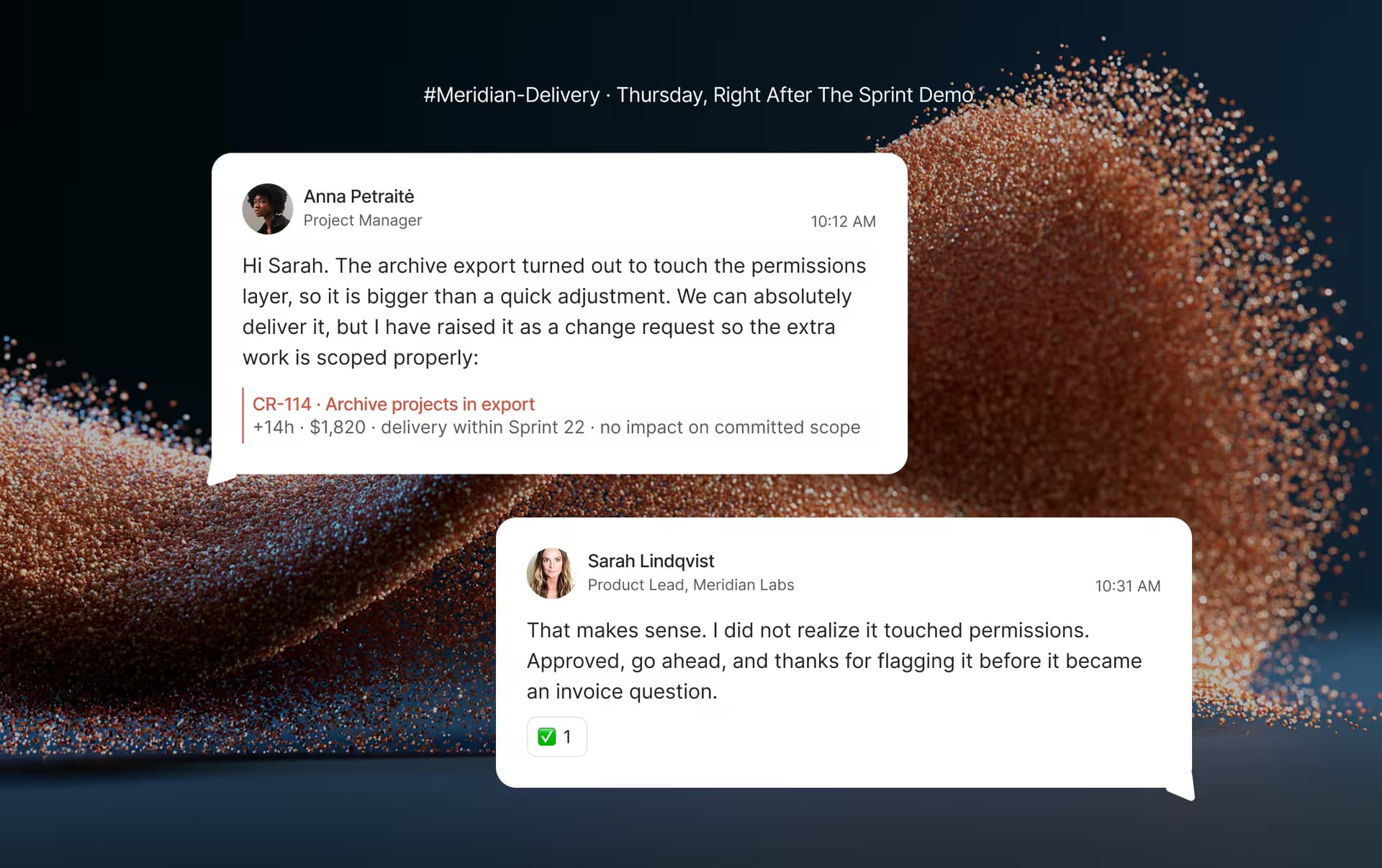
On day two, it is only a scope conversation. By invoice time, it becomes a billing dispute.
The Old Way
The work was real. The agency pays for it anyway.

The Automated Way
Same favor, same goodwill, priced while it's fresh.
Traditional reports tell clients what happened after someone spends time building them. Tolmete gives clients a transparent, up-to-date reporting view when they need it.
Self-Serve
Connect Jira and GitHub, tuned to your projects within days. No credit card, no demo call required.
Talk to Us
For teams 25+ or with enterprise needs: dedicated SLA, SSO, custom integrations, and onboarding support.
Tolmete helps IT service agencies connect project activity, approved time, scope movement, and billing context, so teams can protect the margin they have already earned.