


Green status while the budget drifts
A sprint may look stable while rework, delays, added scope, and blockers build underneath. By the time that pressure appears in a status update, the project may already have used more budget than planned.
Use Case · Margin Protection
Fewer write-offs, stronger fixed-price margins: how agencies surface budget drift in week five instead of discovering it at closeout.
Project Helios ships on a Friday. The client signs off, the team gets its shout-out in the all-hands, the retro is short and friendly. By every visible measure, a success.
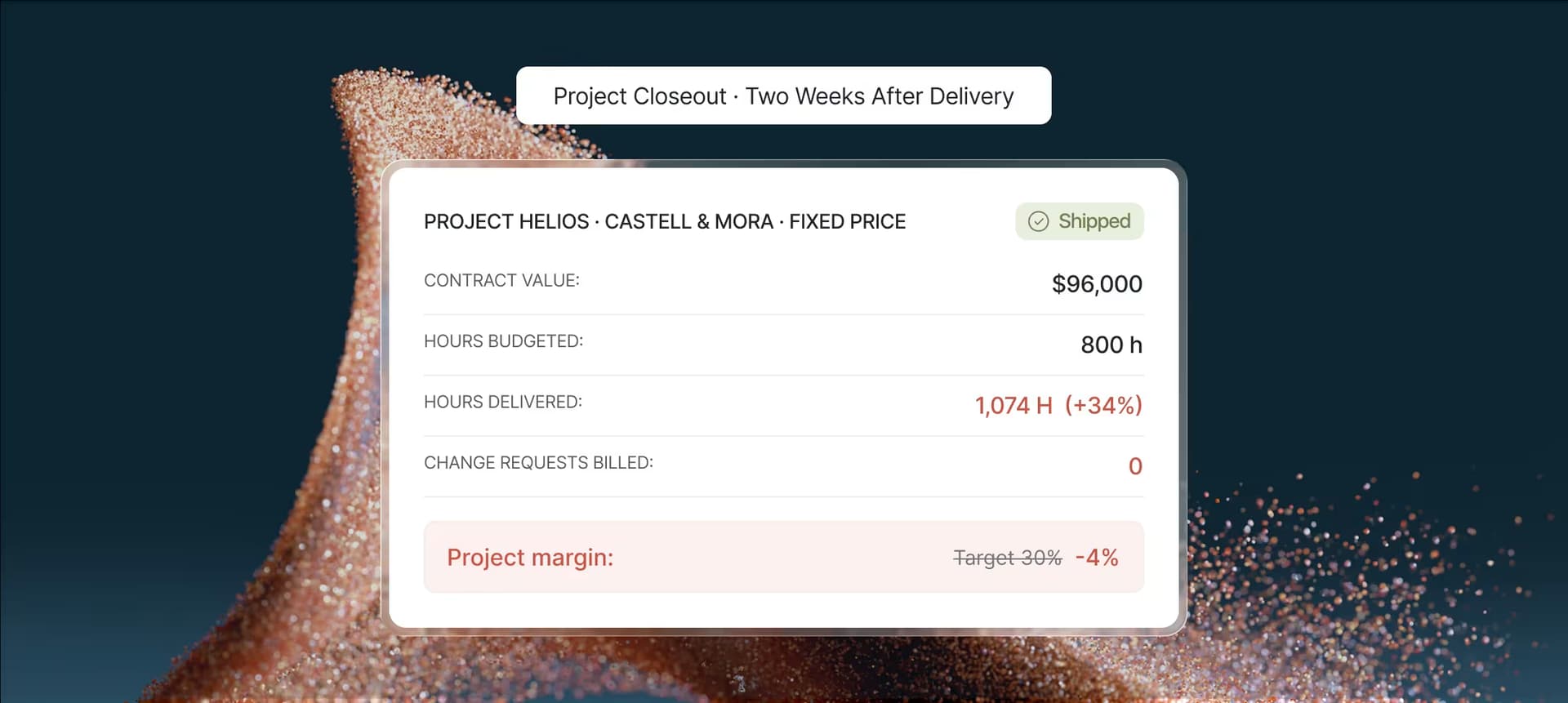
Two weeks later, finance runs the closeout.
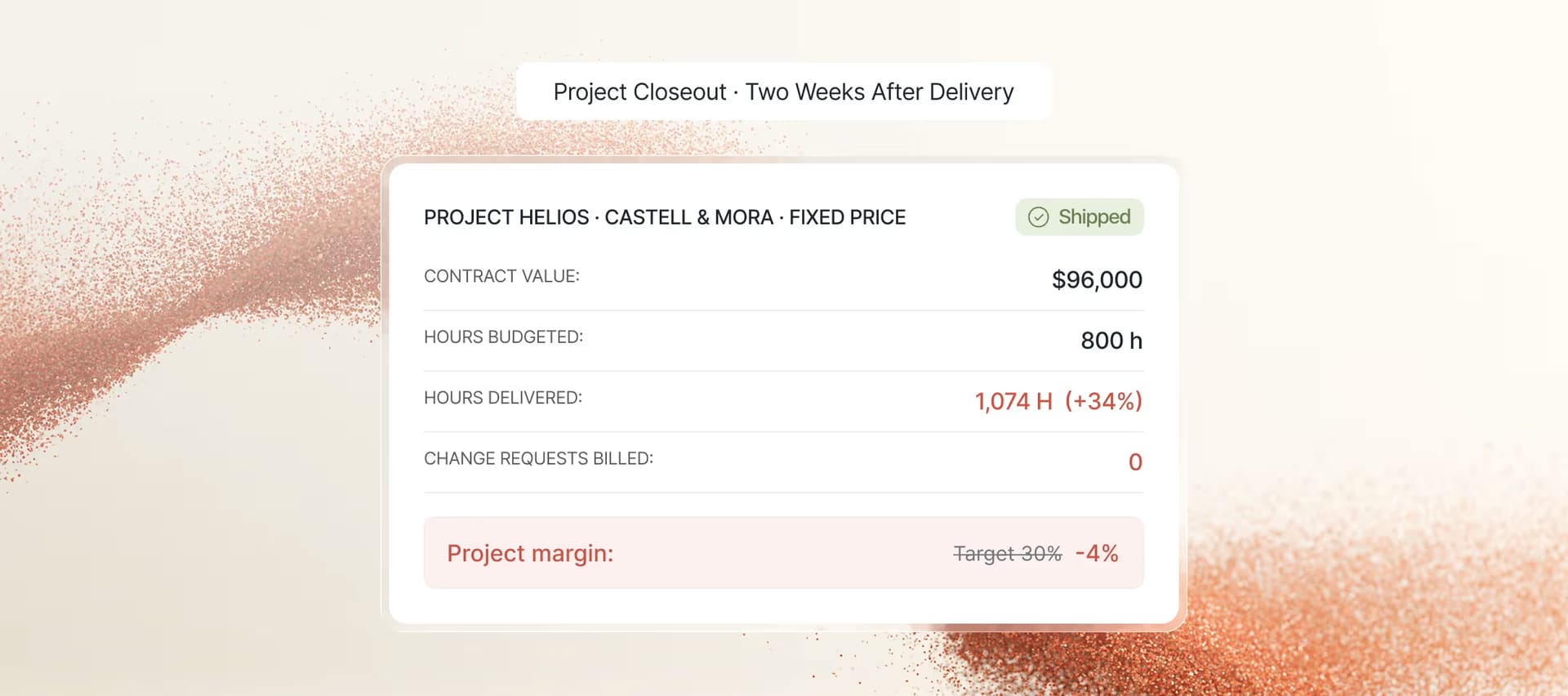
Two hundred seventy-four hours over budget, and no single disaster behind it: no failed sprint, no angry client, no change request, because nothing ever felt big enough to justify one. The hours went into rework here, a misscoped ticket there, a quiet blocker that took a week instead of an afternoon.
On time-and-materials, those hours would have been billed. On fixed price, they came straight out of the margin, and by the time anyone could see it, the only available action was an accounting entry: the write-off.
A fixed-price project can look stable in delivery while the margin is already changing. Tickets are closing, standups sound normal, the status report stays green, and the client may still be satisfied with the pace of work. From the delivery side, the project appears to be under control. Commercially, it may already be moving away from the plan.
Three patterns tend to appear when fixed-price margin starts to weaken.
A sprint may look stable while rework, delays, added scope, and blockers build underneath. By the time that pressure appears in a status update, the project may already have used more budget than planned.
Rework, scope additions, misscoped tickets, and hours without clear context rarely look serious on their own. Together, they consume the contingency first, then the margin, and eventually the profit the project was priced to protect.
Time-and-materials projects reveal effort drift through the next invoice. Fixed-price projects often reveal it at closeout, after delivery is complete and the commercial options are limited. At that point, the agency is not managing the margin anymore. It is explaining the write-off.
The hidden cost of fixed-price drift
27–45%
Typical overrun on fixed-price projects affected by scope and execution drift
Tolmete customer baseline
8 wk
Average lag between drift starting and being detected by the team
Tolmete customer baseline
Up to $90K*
Average margin an agency can protect per year with Tolmete
Tolmete ROI estimate
The usual answer is a monthly margin review: a spreadsheet rebuilt from timesheets after the hours have already been spent. It can explain where the budget went, but it cannot help the team protect it while the project is still moving.
Tolmete brings that commercial view into delivery. It works from the project records your team already creates: time logs, task movement, reviews, blockers, scope changes, and approved delivery context, and compares execution with the plan the fixed price was built on.
Instead of waiting for closeout, the PM can see how the project is tracking against budget, where effort is starting to run ahead of schedule, and which patterns may affect margin if they continue.
The result is a live margin view for each fixed-price project: budget burn against schedule, named risk patterns, and projected exposure tied to the project rate card.
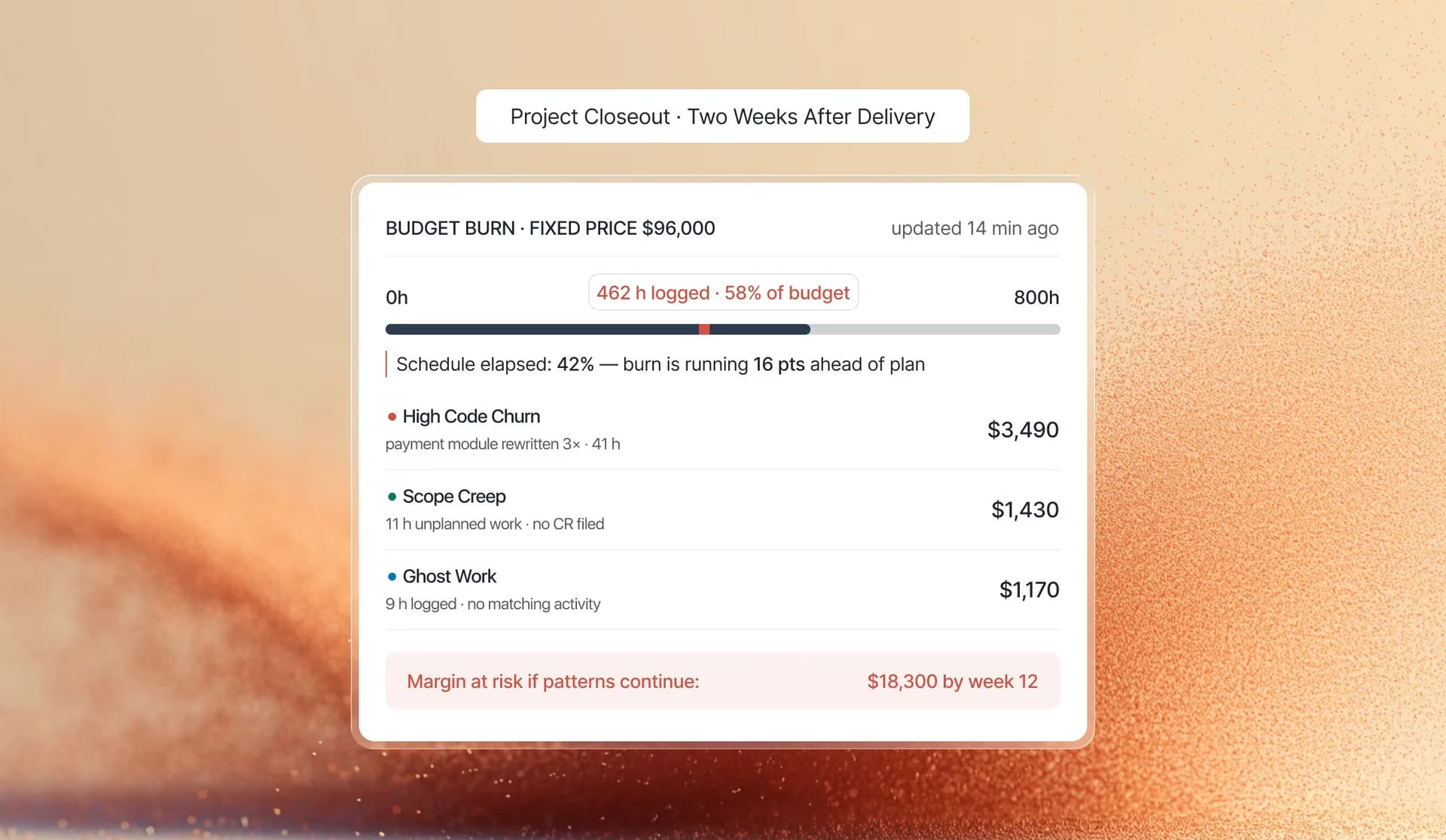
That final projection is the difference. The PM is not relying on a feeling that the project is becoming heavy. They can see where the margin is under pressure, what is causing it, and what the exposure may be by the end of the project.
At week five, that is still a management decision.
At closeout, it is a write-off.
Tolmete does not add another reporting cycle to fixed-price delivery. It works from the project records your team already creates, turning them into a margin briefing the PM can act on while the project is still moving.
Tolmete uses structured work records from connected tools: time logs, task movement, reviews, blockers, ownership changes, scope movement, and visible progress. The team keeps working as usual, without maintaining a separate margin report.
Tolmete checks whether effort, timing, estimates, ownership, and scope still match the plan the fixed price was built on. The baseline stays connected to the project as work develops, instead of being reviewed only at the end of the month.
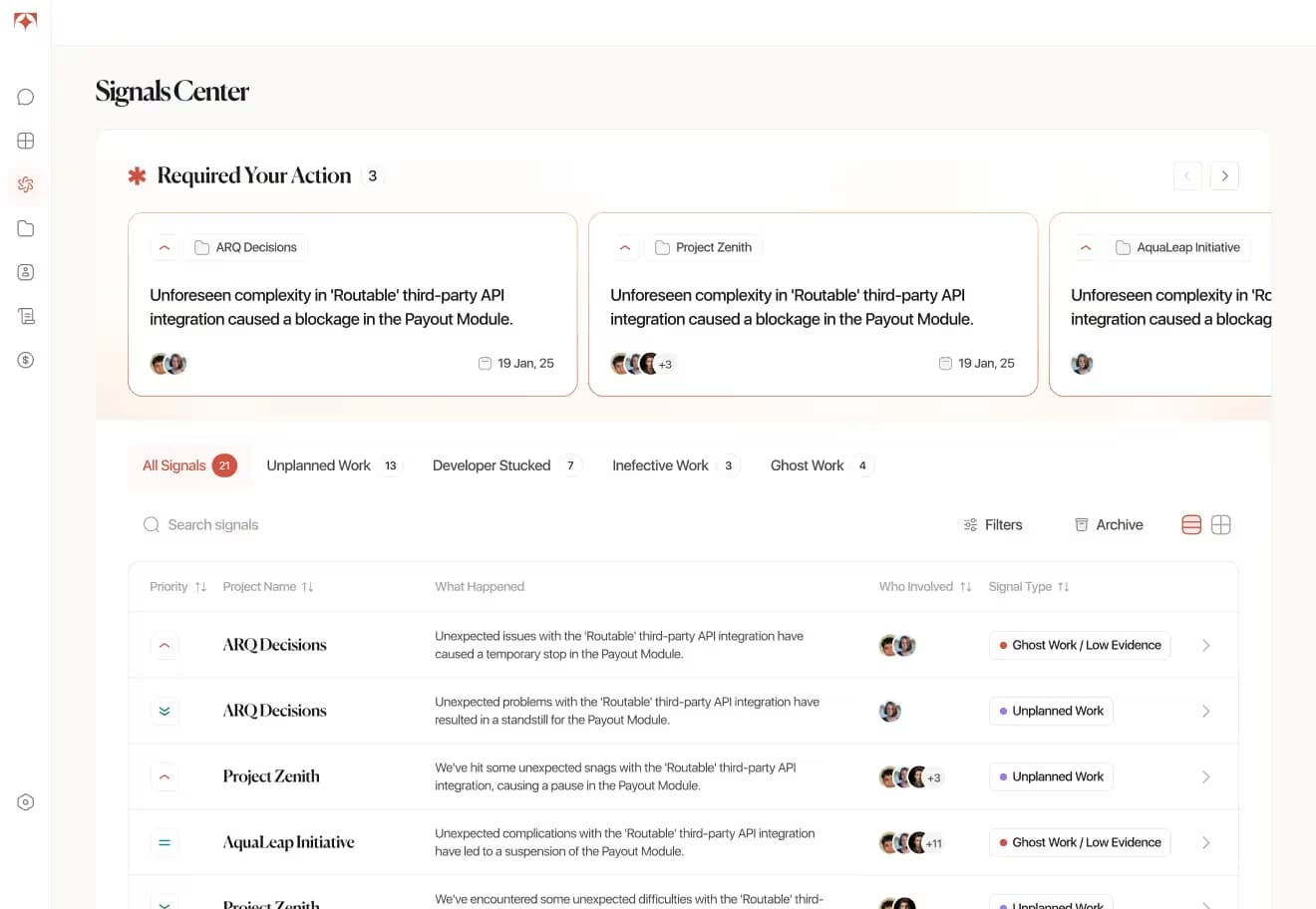
Routine work stays part of the delivery picture. Tolmete focuses attention on named patterns that can drain fixed budgets: scope creep, code churn, unverified activity, execution delay, and estimate drift. Each signal includes a confidence score, so the PM can focus on the risks that deserve action.
The briefing shows what changed, why it matters, what likely caused it, and which action can reduce the risk. Each issue is tied to the rate card and projected against the remaining budget, so the PM can act before the drift becomes a write-off.
Back to Helios. Same team, same fixed price, same quiet leaks, but this time the margin watch is running, and the week-five briefing lands in the PM's inbox before the burn crosses the line.
The churn signal points at the payment module: three rewrites with one root cause, an ambiguous integration spec. A senior engineer pairs on it for two days and the rewriting stops. The eleven unplanned hours are treated as a change request, which the client approves the same week. The unverified activity gap turns out to be a contractor logging against the wrong project, traced to its source the same week rather than discovered at reconciliation.
None of these fixes is heroic, and that is the point: in week five they are routine management. In a closeout report, they would have been a write-off.
On time-and-materials, drift reaches the next invoice.
On fixed price, it reaches your margin.
Without Tolmete
The margin was lost in weeks 3–9. It was discovered in week 14.

With Tolmete
Same project, same leaks, surfaced while a fix was still an option.
Portfolio margin visibility before risk reaches the client.
A live burn picture instead of a month-old spreadsheet.
Clear change requests mid-project, without an end-of-project standoff.
For a project manager, margin watch replaces the end-of-month spreadsheet review with a live view of budget burn, delivery patterns, and projected exposure. The project no longer has to wait until closeout for the team to understand where margin is moving.
For agency leaders, the value is broader. The portfolio stops being a collection of green status updates. It becomes a clearer commercial view of fixed-price delivery: which engagements are tracking to plan, where contingency is being consumed, and which projects need attention before the risk reaches the client.
That visibility also improves future pricing. Each drift pattern Tolmete surfaces helps the agency understand where estimates tend to run hot, which project types need more contingency, and where delivery plans should be adjusted before the next fixed-price proposal is signed.
Tolmete is designed to fit the tools your team already uses. Connect your delivery tools, set the budget baseline, and keep margin visibility active while the project moves.
Every signal is priced from your own rate card and projected to the end of the project, while there is still time to act.
(GitHub, Jira, Slack ~3 min per tool)
Budget, estimates, rate card
Live burn + drift signals
Fixed-price work is winnable business: clients want price certainty, and agencies that can deliver it profitably have a real edge. The pricing model is rarely the risk. The real exposure is running a fixed budget with visibility built for time-and-materials, where drift waits for the next invoice to announce itself.
Make the burn visible in week five instead of week fourteen, and the write-off will no longer be a cost of doing business. It becomes what it always should have been: a preventable event.
Spot the drift while there's still runway. Act mid-project. Keep the margin you priced in.
Self-Serve
Connect your tools and publish your first digest before this month's report is due. No credit card, no demo call required.
Talk to Us
For teams 25+ or with enterprise needs: dedicated SLA, SSO, custom integrations, and onboarding support.
Tolmete helps IT service agencies connect project activity, approved time, delivery evidence, and client context, so clients can see the work they are paying for without having to ask PMs to rebuild the story by hand.