


Use Case · Client Trust

Defend every invoice with proof-of-work

Fewer billing disputes, lower client churn: how agencies back every invoice with a clear record of the work.

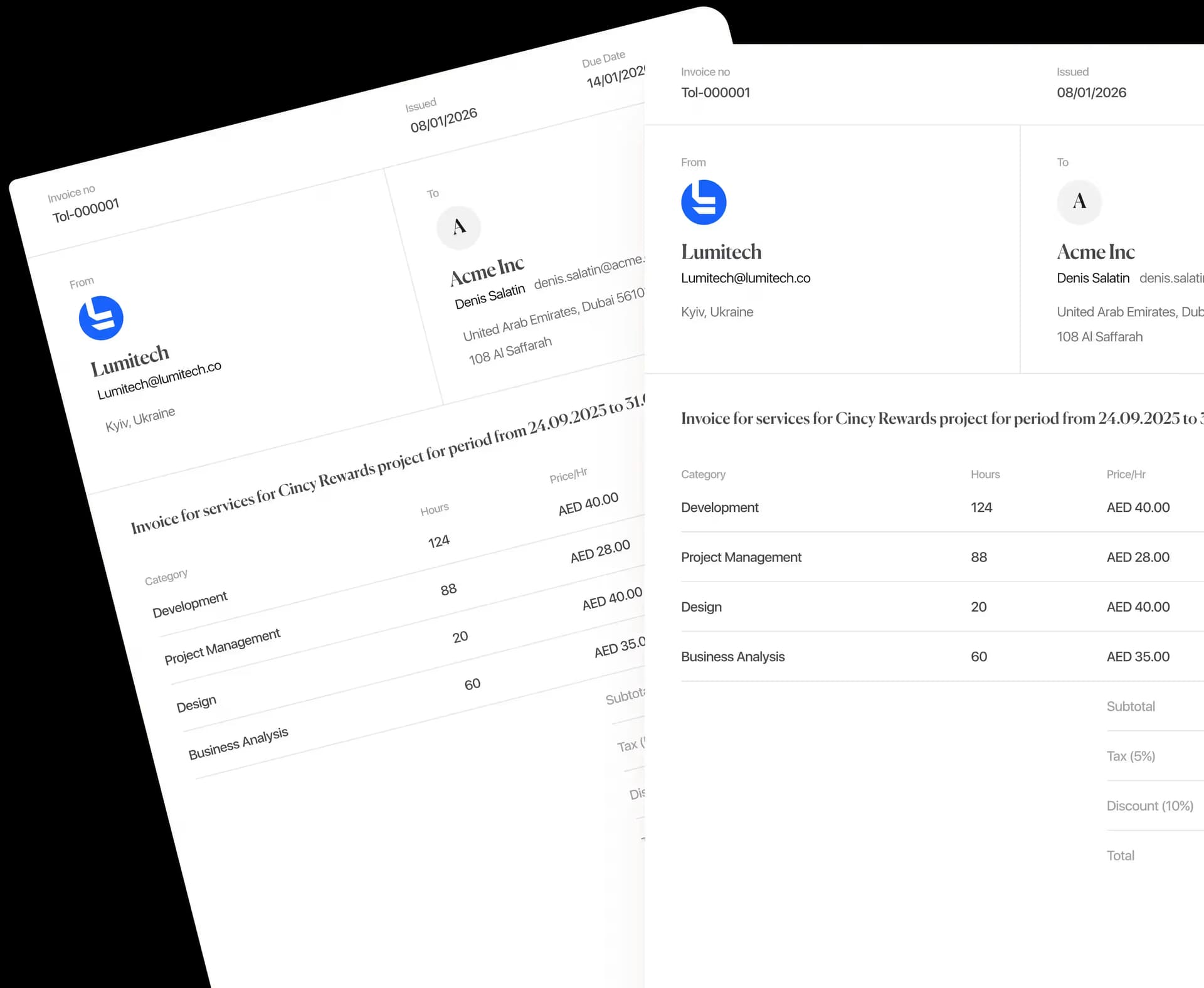
Tolmete proof-of-work invoicing preview — invoice backed by delivery activity and logged hours

Invoices arrive on time
Clients still ask what they paid for

The invoice goes out on the 1st of the month, every month. The billing cycle runs like clockwork: timesheets submitted, hours tallied, invoices generated, reliably and on time.

Then the reply arrives.

Email from Michael Kerr, VP Finance at Hartwell & Co, questioning 34 hours of backend refactoring on invoice #128

The project manager knows exactly what that work was: three interconnected fixes to the data pipeline, prompted by a client-requested UI change two sprints earlier. Necessary, real, logged to the hour.

Setting that out in terms the client can follow, backed by evidence they trust, is a different task altogether. And it recurs every month.

The gap costs more than the reporting ever did

Most agency-client relationships run on email threads and monthly status calls. The client asks what was done this month. Someone pulls numbers from Jira, builds a spreadsheet, writes a summary, and sends it, hoping it lands before the invoice.

Between the work that happens and the moment the client sees it, trust has to hold on its own. When projects run long, scope expands, or hours are harder to explain, that gap becomes a problem. Clients who cannot see the work form their own picture, and that picture is rarely generous.

Which is why the same pattern repeats on almost every project:

Reporting takes time no one budgeted for

Every client update starts from a blank page: pull the logs, assemble a spreadsheet, turn it into something a client can follow. The work is routine, yet it quietly consumes hours the team never planned to spend, month after month.

Clients question the hours they never saw

When the only record of a month's work is an invoice and a status email, even accurate billing invites pushback. The issue is rarely the work itself. It is that the client had no way to watch it happen while it did.

Trust erodes before anything visibly breaks

Silence between updates leaves room for assumptions, and assumptions rarely favor the agency. A concern raised at invoice time has usually been forming for weeks. That slow doubt is expensive: every invoice gets harder to approve, every conversation more guarded

How Tolmete approaches this

Most reporting explains the invoice Tolmete shows the work behind it

Most agency-client relationships run on email threads and monthly status calls. The client asks what was done this month. Someone pulls numbers from Jira, builds a spreadsheet, writes a summary, and sends it, hoping it lands before the invoice.

Tolmete changes the timing of that context. It connects time logs, task movement, delivery events, and PM-approved Signals into a client-facing account of the project as it develops. The team keeps working in the tools already in place, while the client gets a clearer view of what changed, what was completed, and where the effort went.

The result is a standing record around the work: plain-language summaries, controlled visibility, and enough context for the client to make sense of the invoice when a question comes up.

  1. Team works in existing tools

    Jira, time tracker, Git: nothing new to log

  2. Tolmete connects the work

    Time logs, task activity, and delivery context

  3. A client-ready summary is prepared

    In plain language, at the project level

  4. The portal updates

    With the reports and Signals the PM chose to share

Transparent for the client Controlled by the agency

Automated visibility only works when the agency decides what becomes visible. Tolmete keeps the PM between internal project activity and the client view, so the portal is never an open export of everything your tools recorded.

  1. Nothing publishes without PM approval

    Tolmete prepares summaries and Signals, but they do not reach the client until the PM reviews and releases them. The agency decides which project context is ready to share.

  2. Internal work stays internal

    Clients see a clear account of the work without internal comments, side conversations, or unfiltered logs. What becomes client-appropriate remains the PM's decision.

  3. The portal is private by default

    Each client view is shared through a unique, unlisted link with no client login required. Only the people the PM shares it with can access it.

  4. Access can be withdrawn at any time

    If a project requires greater privacy, the PM can take the portal offline with one click. Client visibility is granted by the agency, which remains in control.

Inside the client portal

Everything a client needs to trust
the work

The Tolmete client portal gives clients a clear, structured view of what happened on their project, without requiring them to ask. Each section answers the questions clients have but rarely say out loud.

1. Project Overview

01/04

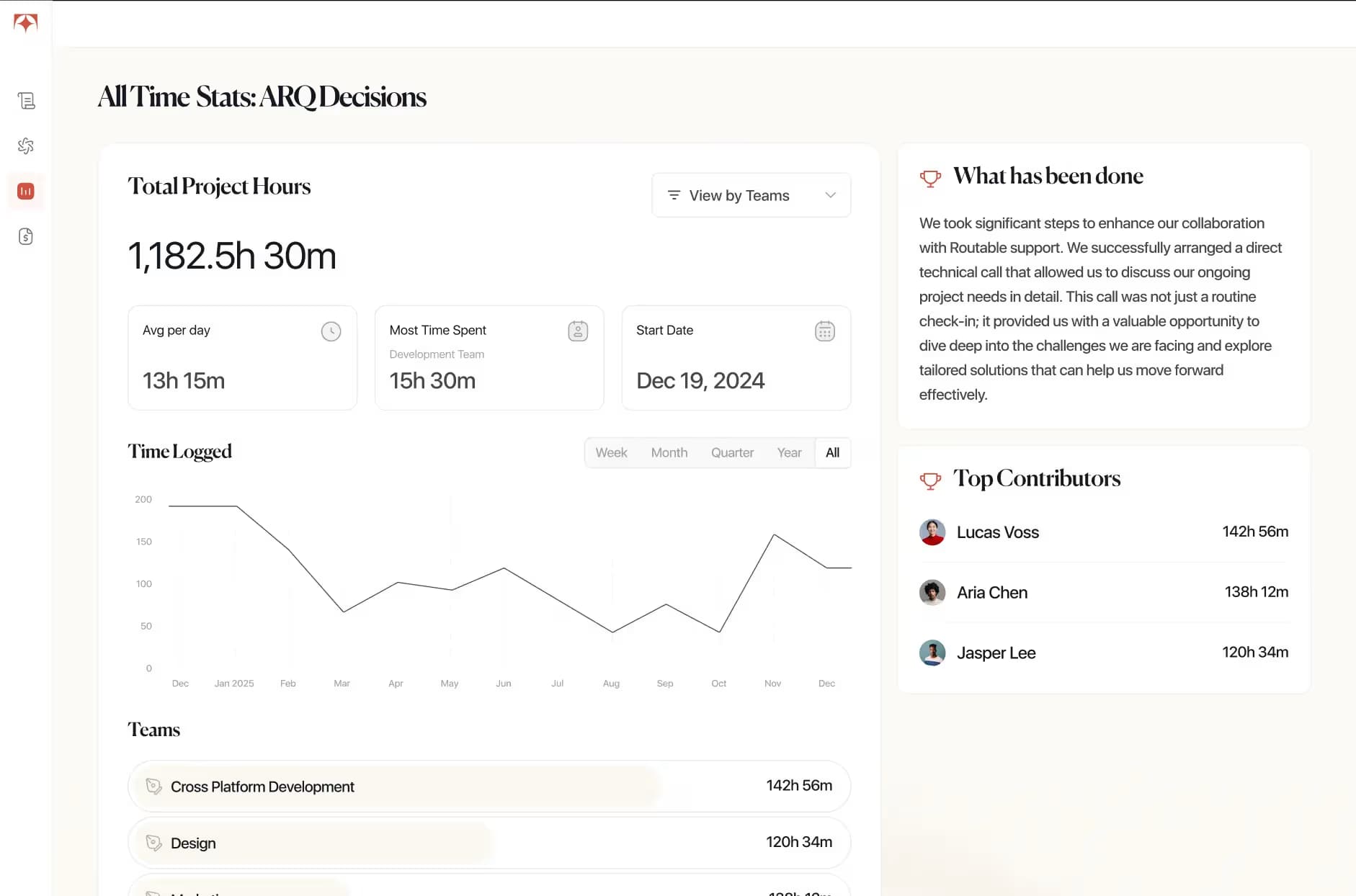
A monthly view of delivery progress with project, team, and contributor context in one place. Clients get the executive view first, with daily time logs available when details need to be reviewed.

Tolmete client portal — project overview with monthly delivery progress and contributor context

The hidden cost of scope creep

Your contributors keep working in the tools they already use: they log time, close tickets, move tasks forward, and update project work as usual. Tolmete turns that activity into a client portal that stays aligned with the project. The PM publishes the portal once, shares a single link with the client, and controls whether the project view remains available or is taken offline.

After setup, the portal refreshes on the first of each month, giving the client a current view of the work whenever a billing question comes up.

Connect

Time tracking & delivery tools

Tune

The portal, one click

Detect

One link, no client login

Client reporting becomes part of the workflow

The reporting cycle shifts the moment the PM stops beginning each month from a blank page. Rather than gathering Jira updates, time logs, blockers, and technical notes once the work is finished, the portal keeps the client-facing account close to the delivery as it unfolds. The PM still decides what is shared, but the monthly report no longer rests on someone reconstructing the entire project from memory.

For agency leaders, this establishes a consistent standard for client visibility across all accounts, without requiring each PM to maintain an additional reporting routine.

Agency leader

Better margin visibility across the client portfolio

Project manager

Earlier scope conversations with clearer context

Client

Clear change requests, not invoice surprises.

What happens to the invoice dispute

Back to that 9:04 AM email.

Same invoice. Same 34 hours of backend work. Same client who was not expecting it.

This time, the client has had access to the portal since the project kicked off. By the time the invoice arrives, the May update is already there: the monthly time chart, the "What Has Been Done" summary, and the link between the backend work and the Sprint 14 dashboard filtering request.

The invoice is no longer the first place the client sees the explanation. It confirms work they have already been able to review.

When the invoice lands, there is nothing to dispute.

Email from Michael Kerr approving invoice #128 after reviewing pipeline work in the client portal

Make the work clear before anyone has to defend it.

The Old Way — Without Tolmete

  • "Tiny thing" enters and piles up
  • 8 weeks pass unnoticed
  • Invoice shock
  • Discount, or write-off

The work was real. The agency pays for it anyway.

The Automated Way — With Tolmete

  • "Tiny thing" enters the sprint
  • Signal fires on day 2
  • CR raised, billed
  • A named mitigation plan, not a notification

Same favor, same goodwill, priced while it's fresh.

Reporting was never the job It was the workaround

Agencies did not begin writing monthly reports because reporting was the work. They did it because clients needed evidence, and the project itself had no clear place to hold it.

Over time, the workaround became routine: collect the logs, translate the work, explain the hours, defend the invoice, repeat next month.

Tolmete changes where that context lives. It does not appear only after the invoice has become a question. It takes shape while delivery is still underway, with the agency deciding what the client sees.

The result is a calmer billing conversation: fewer surprises, fewer disputes, and less time spent defending work the client could have understood earlier.

Self-Serve

Start free in 7 minutes

Connect Jira and GitHub, tuned to your projects within days. No credit card, no demo call required.

  • Free for teams up to 7 people
  • All 5 signals included
  • Cancel anytime, no contract
Start Free Trial

Talk to Us

Get a custom walkthrough

For teams 25+ or with enterprise needs: dedicated SLA, SSO, custom integrations, and onboarding support.

  • 30-min product walkthrough
  • Custom ROI analysis for your team
  • Implementation roadmap

Tolmete helps IT service agencies connect project activity, approved time, scope movement, and billing context, so teams can protect the margin they have already earned.