


Even when everything looked normal:
The project looked "green" on the dashboard
Tasks were closed
Hours were logged
The team was clearly working
Our Story
Tolmete didn't start as a product we wanted to sell.
It started as a tool we had to build — just to keep projects healthy, margins safe, and clients' trust intact.
10+ yrs
Inside service delivery before we started building Tolmete
100s
Of projects watched quietly leak margin while looking "fine"
1
Pattern that kept repeating — and that we built Tolmete to break
How Tolmete was Born
Tolmete did not appear as another startup pitch or a desire to "build one more SaaS". It started from a much less romantic place: everyday operational pain.
We spent years inside service delivery, building digital products for different types of companies. Complex platforms, AI systems, internal tools, consumer apps — the tech stack was always changing, but one thing stayed the same: it was too easy to lose money on projects that looked "fine" from the outside.
We spent years inside service delivery, building digital products for different types of companies. Complex platforms, AI systems, internal tools, consumer apps — the tech stack was always changing, but one thing stayed the same: it was too easy to lose money on projects that looked "fine" from the outside.
Tolmete was born exactly in this gap between "everything seems okay" and "why did we not see this coming earlier?"
The Pattern
After some time, we understood that this was not one or two unlucky projects. It was a pattern.
The project looked "green" on the dashboard
Tasks were closed
Hours were logged
The team was clearly working
When margin was already lost
When a client started to doubt the numbers
When trust was at risk
It was rarely one big failure. More often, it was a collection of small things — a "quick change" that turned into heavy work, a task that stayed open for weeks but still "in progress", logs that didn't really match reality. And this "too late" moment was repeating from project to project.
The Systemic Gap
In the service world, "transparency" often means another CSV export. A time report with a list of hours. A time tracker that shows activity, but explains nothing.
Inside the team, it's not much better. People log time because they "must", not because they see real value. Logs are written in a rush, at the end of the day or week, often from memory.
And sometimes "transparency" becomes something even worse: pure control. Screenshots of monitors. Keystroke recording. Activity scores. Micromanagement disguised as analytics.
The client usually has no clear answer to simple questions:
What is actually happening inside the project?
How will this story end if we change nothing?
Why does something take more time than expected?
Where are the risks right now?
This was not the type of transparency we believed in. It didn't help to understand the project. It didn't help to protect margins. It just created stress and extra work.
The Realization
The main insight for us was very simple
Insight
The problem isn't in people. It isn't even in hours.
The problem is that almost nobody sees the real picture of the project while it is happening.
Most tools either show the plan (roadmaps, backlogs, sprints), or show the past (dashboards, monthly reports), or require a lot of manual reporting just to stay accurate. But very few tools try to answer the real question: What is actually happening with the project right now — and where will this lead if we continue in the same way?
What We Built
Tolmete started as an internal system, not a commercial product.
We built it for ourselves first — and we were very clear on what it should not become.
No screenshots, no keystroke recording, no activity scores. The work is the data, not surveillance.
No rigid timesheets. Contributors describe their work in a sentence — Tolmete handles structure.
The platform reduces manual reporting, never adds to it. Your best people stay focused on the actual work.
Time logs, Jira tickets, Git activity, calendars. The unified picture of what's actually happening.
Not simple if-then rules. AI sees patterns across signals and explains what they mean for margin and delivery
Every signal explains why a risk appears — and where the project will end up if it's ignored.
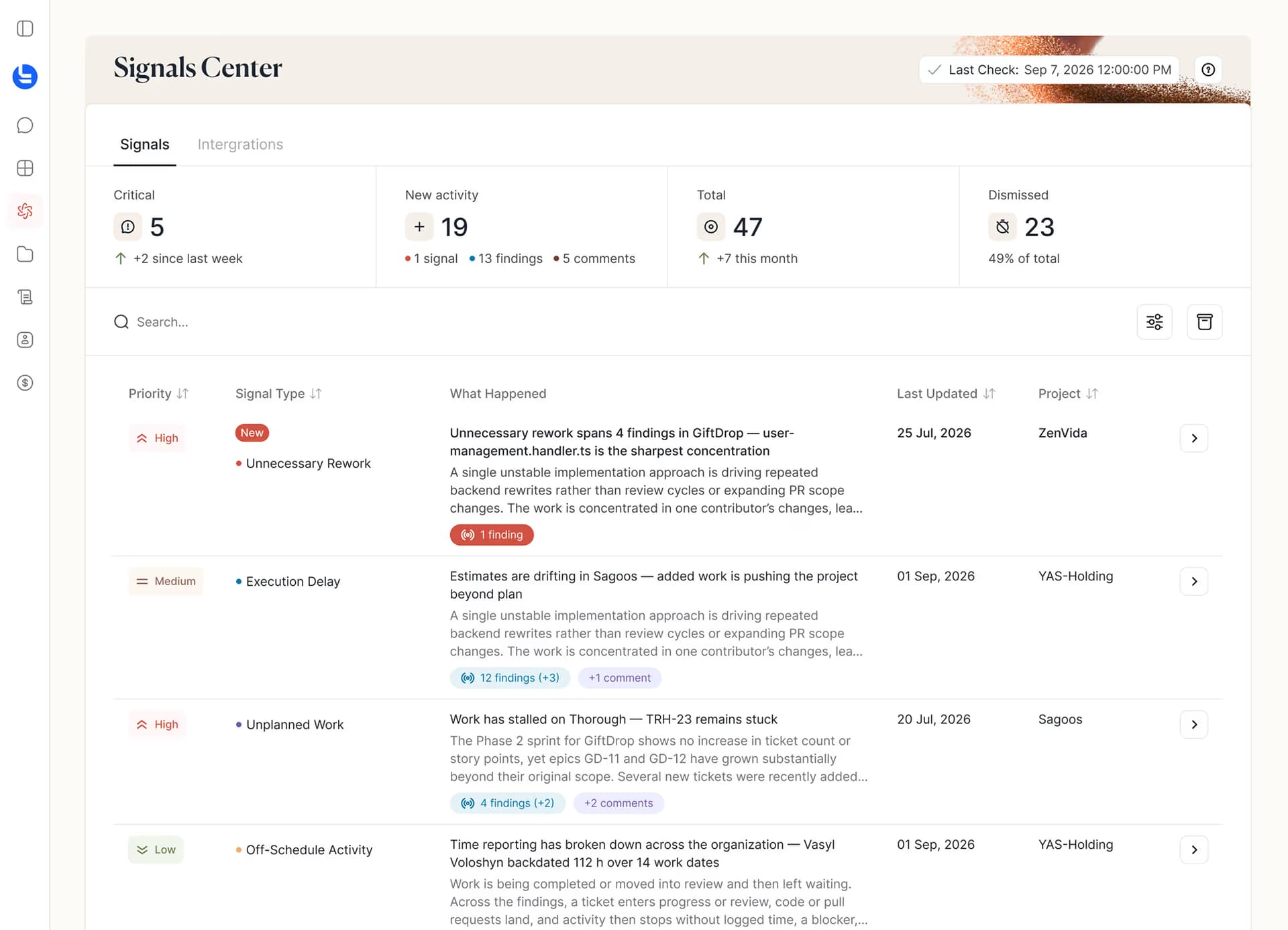
That's why Tolmete is built as an AI-first Decision Intelligence platform. It moves from passive time tracking to active risk auditing — an automated 24/7 project auditor that reads the unified activity stream and looks for margin leakage: unpaid work, inefficiencies, stagnation.
Our Team
We believe great AI products are built by diverse teams with complementary skills. That's why our engineers, designers, product managers, and AI specialists work together from day one, ensuring every decision supports both user experience and business objectives.
The Turning Point
Over time, it became obvious that this problem lives far beyond our own projects.
We started to see the same pattern at other service companies, agencies, design and creative studios, tech teams, consultancies. Different industries, different tech stacks, different clients — but the same core issues.
Profit leaking inside "successful" projects
Risks surfacing when it's already too late
Hours that are hard to defend in front of a client
Transparency that overwhelms or doesn't exist
At some point, Tolmete stopped being "our internal system" and became a product.
Not because we wanted to "enter the SaaS market" — but because the solution we built for ourselves clearly matched the pains many other teams were facing.
The Systemic Gap
Tolmete is a system that grew from real projects, real mistakes, and real financial losses — and from the desire to avoid repeating them. These are the principles we won't compromise on.
We focus on margin risks, not on optimizing people or tracking every move. The goal is profitable projects — not panopticon dashboards.
We show real project progress based on evidence, not just status updates. Tickets, commits, meetings — the work is the data.
We spot risks early with live data instead of analyzing what went wrong later. The goal is catching issues fast — not explaining failure after it happens.
AI watches the activity stream so humans can focus on judgment. It assists project managers — it doesn't replace them.
Real project work is messy. Tolmete keeps the team's internal view honest while presenting clients a clean, structured view.
We've delivered, we've over-served, we've absorbed scope creep, we've explained late projects to clients. Tolmete is shaped by that experience.
That's why Tolmete is built as an AI-first Decision Intelligence platform. It moves from passive time tracking to active risk auditing — an automated 24/7 project auditor that reads the unified activity stream and looks for margin leakage: unpaid work, inefficiencies, stagnation.