Deep Integrations

Connect your tools. Detect Delivery Risk Earlier

Tolmete connects the tools your agency already uses — from code repositories and project boards to chats and calendars. Each integration gives Tolmete more delivery context, turning scattered activity into early risk signals that protect deadlines, margins, and client relationships.
See It in Action
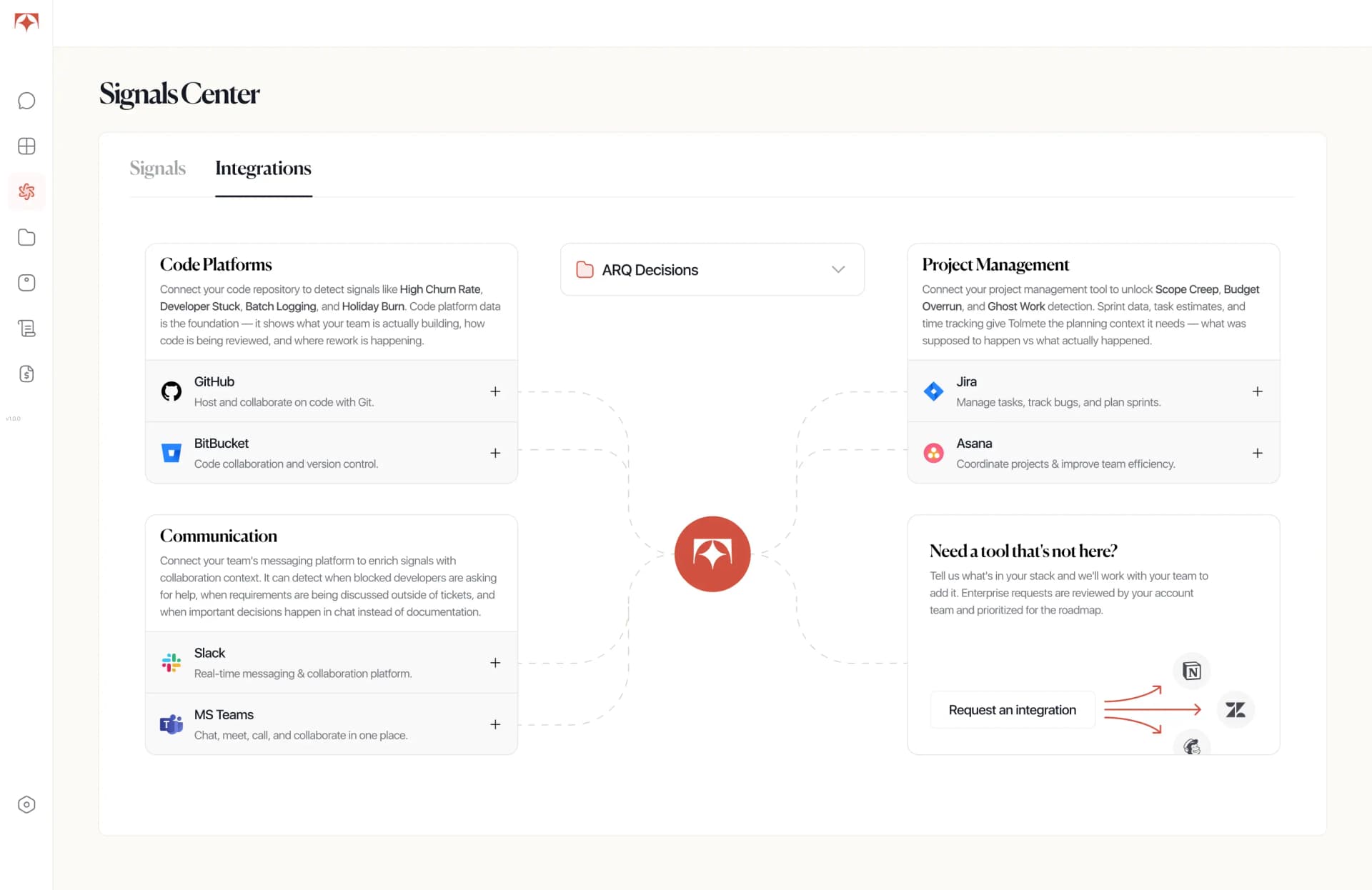
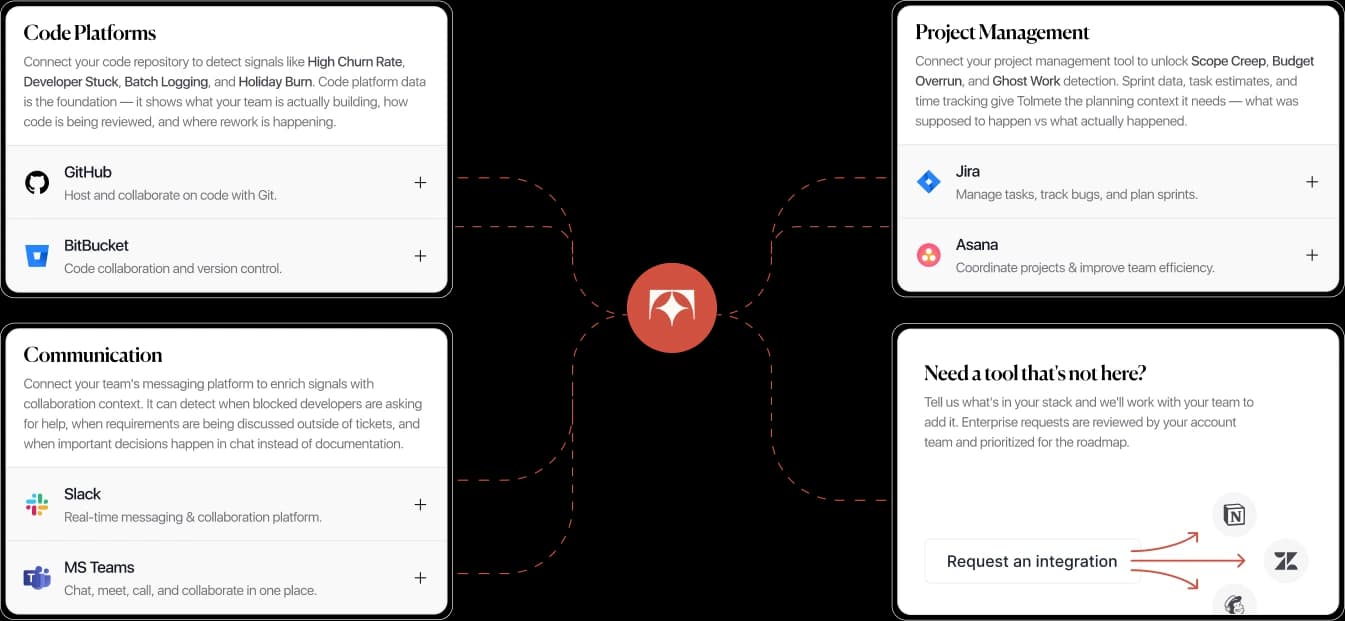
Tolmete deep integrations preview — Signal Centre connecting GitHub, BitBucket, Jira, Asana, Slack, and MS Teams

Why It Matters

Connecting tools is not the end goal

Connecting your tools gives Tolmete the context it needs to see what is actually happening across your agency. That context becomes Risk Signals, early warnings that show where work is drifting before it affects a deadline, a margin, or a client conversation.

Early Warning System

Code activity, task changes, and blockers combine into a single delivery picture that Tolmete reads continuously.

Workflow Bottleneck Detection

When work slows across tools, Tolmete surfaces the pattern and explains where the friction is building.

Richer AI context

Each integration gives Tolmete a richer context about your delivery patterns, making subsequent signals more precise.

Proactive Risk Signals

Signals arrive with evidence and a recommended action while there is still room to act.

Integration Library

Every Connection Unlocks
A New Layer of Insight

Each category gives Tolmete a new view of delivery activity and activates new Risk Signals for your agency.

Code Platforms

Track commit frequency, PR cycle time, and review bottlenecks. Tolmete reads activity patterns — metadata only — never the source itself.

Signals enabled:
Stalled PRs,How it works,Review delays,Inactivity spikes

Project Management

Monitor ticket aging, sprint velocity drift, blocked tasks, and scope creep — the signals that hide in plain sight on every board.

Signals enabled:
Scope creep,Sprint drift,Blocked tickets,Aging cards

Communications

Detect response lag, silence patterns, and unusual message volume — strictly within project channels you authorize. Private chats stay out of scope.

Signals enabled:
Response lag,Silent contributors,Volume anomalies

Calendars

Turn meetings into time logs and schedule the right follow-up when a risk needs action — without manual reconciliation.

Signals enabled:
Meeting overload,Auto time-logs,Follow-up gaps

How It Works

From Connection to Early Warning

Tolmete deep integrations — connect your delivery stack with read-only access

The Problem

We See Delivery Patterns,
Not Private Data

Your proprietary work stays yours. Tolmete does not store source code, read private conversations, or access document contents. The goal is to understand delivery movement — not monitor personal behavior.

Zero code storage

Tolmete reviews GitHub and BitBucket activity patterns, not source code. It tracks commit frequency, pull request movement, review timing, and code-change patterns.

Project channels, not private messages

Tolmete limits Slack and Teams analysis to approved channels tied to delivery workflows. Personal chats and non-project spaces stay out of scope.

Delivery patterns, not surveillance

Tolmete builds Risk Signals from workflow movement, timing, response patterns, blocker signals, scope changes, and approvals — not from message content.

More Delivery Context.Earlier Risk Signals

Connect your first integration in minutes and let Tolmete start turning delivery activity into early Risk Signals.

Start a Free Trial

FAQ

Frequently Asked Questions

Everything you need to know about Tolmete.

Deep Integrations are Tolmete’s connections to the tools your team already uses, such as GitHub, BitBucket, Jira, Asana, Slack, Teams, Google Calendar, and Outlook. They help Tolmete understand real delivery activity across code, tasks, communication, and calendars, so the platform can detect early Risk Signals before small problems become delivery issues.
Without integrations, Tolmete has less context behind a project. By connecting the tools where work already happens, Tolmete can analyze commits, pull requests, task changes, blockers, meeting load, and communication patterns to detect early warning signs before they affect delivery.
Tolmete can detect signals such as stalled pull requests, inactivity spikes, velocity drops, scope creep, blocked tickets, overdue tasks, dependency bottlenecks, meeting overload, and silent periods leading up to critical deadlines.
Tolmete uses activity signals such as timestamps, activity frequency, pull request status, ticket changes, blockers, sprint updates, calendar load, response patterns, and approved project-channel workflow signals. The goal is to securely detect anomalies and workflow bottlenecks, not to inspect private conversations or sensitive content.
Tolmete can begin analyzing project activity after an integration is connected. If historical data is available, Tolmete can surface an initial signal during setup; if there is not yet enough data, it confirms the connection and begins monitoring as activity builds.
Traditional dashboards usually show what has already happened. Tolmete uses integrations to detect what may be starting to go wrong, explain why it matters, and recommend what to do next while there is still time to act. That is the shift from reactive reporting to proactive delivery intelligence.