
Too Much Investigation
Delivery risks often reach managers as client escalations, sprint failures, or margin pressure. By then, they have to reconstruct what happened before they can respond.
AI Mitigation Plans
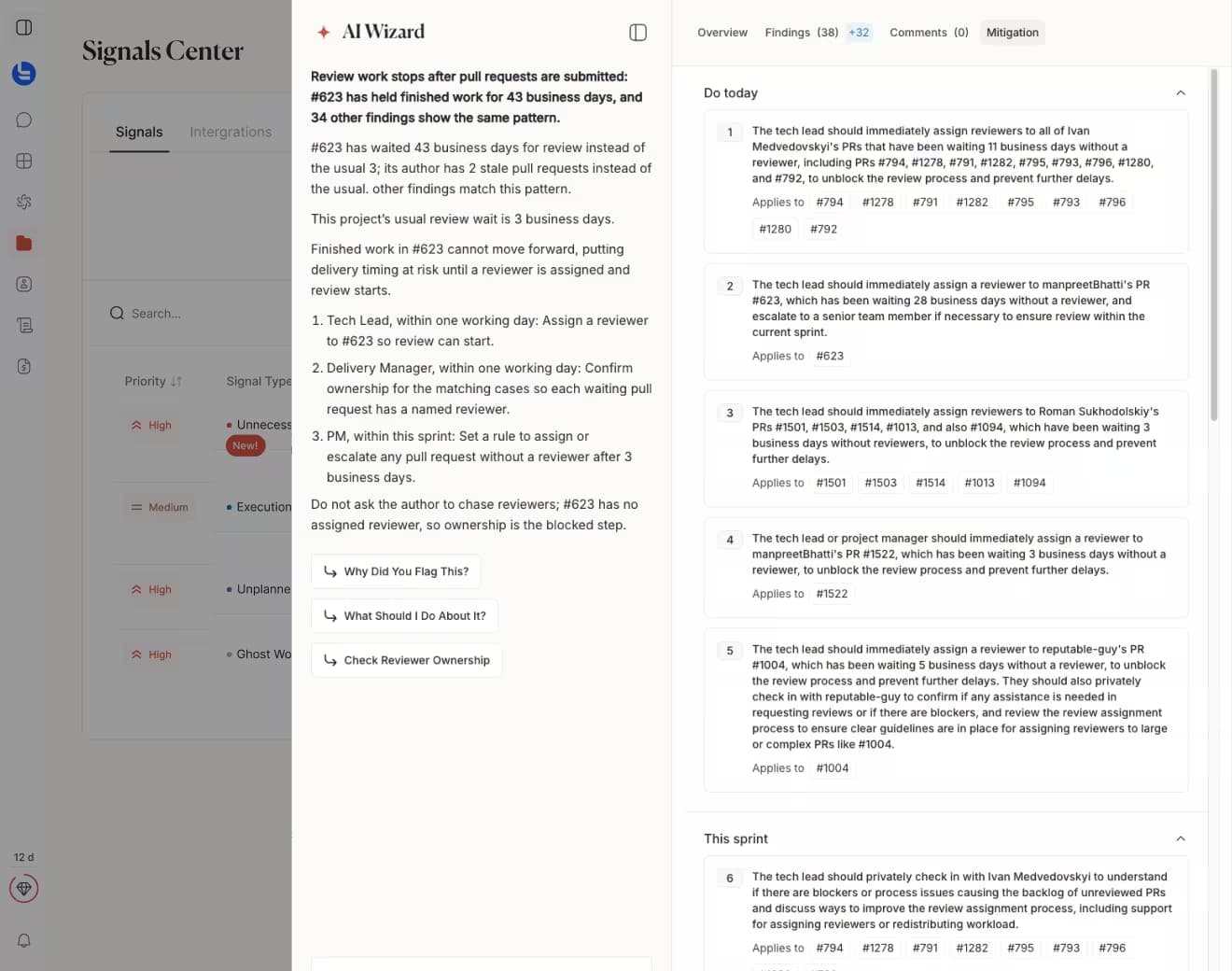
Tolmete turns every delivery risk into a mitigation plan: what happened, who responds, what needs to change, how urgent it is, and the action's expected impact. Managers move from alert to resolution with a plan, not another problem to investigate.
The Problem
Most project tools can show when something is wrong: a delay, an off-target estimate, a red KPI, or a stalled task. But seeing the problem is only the first step. Managers need to know what caused the risk, who should act, what needs to happen now, and which decision can prevent the issue from growing.
AI risk mitigation for project management becomes valuable when it connects each risk to a specific owner, action, and timeline. Tolmete does this while there is still time to act.
Delivery risks often reach managers as client escalations, sprint failures, or margin pressure. By then, they have to reconstruct what happened before they can respond.
Generic advice like “improve communication” or “review the process” sounds reasonable, but it does not define the action, owner, urgency, or next decision.
A red metric can show that something is wrong, but it does not assign responsibility. Managers still need to know who should act, what needs to happen, and when.
Most billing tools wait for data to arrive.
Tolmete connects it the moment work is logged.
Inside the client portal
AI Mitigation Plans are not generic templates. Tolmete generates each plan from the actual signal context: root cause, people involved, sprint timeline, billing model, delivery evidence, and business impact.
AI Mitigation Plans help managers move from “we have a problem” to “this is what we do next.” Every plan answers three questions:
Who’s responsible for fixing it?
When should it happen?
What needs to change right now?
Signal Detected
Root Cause Analyzed
Action Owner Identified
Mitigation Plan Generated
Manager Acts With Clarity
This may include execution delays, unplanned refactoring or code rewriting, scope creep, ghost work, stalled progress, or an overrun of the estimate.
Tolmete reviews timelines, tickets, activity patterns, code changes, scope movement, blockers, and communication context to understand why the risk is forming.
A scope change, technical disagreement, underestimation, silent blocker, or margin risk each requires a different response, especially across fixed-price and time-and-materials projects.
The plan separates sprint risk management into three layers: what needs attention today, what should be handled this sprint, and what should change next sprint to stop the issue from repeating.
Every mitigation plan is organised by urgency — what to act on today, what to resolve this sprint, and what to change before the pattern repeats.
Action Plan
Every mitigation plan is organized by urgency: act today, resolve this sprint, prevent the next sprint.
Level 1
Contain the issue before it grows
Schedule a 15-min check-in between the tech lead and the developer to understand what’s blocking progress.
Split a large PR so the stable part ships while the new requirement gets handled separately.
Pause newly added tickets until scope changes are approved.
These actions help managers clarify the blocker, reduce immediate delivery pressure, and keep the project moving while the wider plan is reviewed.
Level 2
Fix the current risk and realign expectations
Re-estimate the ticket based on the complexity discovered during implementation.
File a change request for unplanned work added to the sprint. On a fixed-price project, this is the window where margin is still recoverable.
Move scope-creep tickets into the next sprint with clear re-prioritization against current commitments.
These actions address the root cause of the current issue. They may involve re-estimation, scope adjustment, stakeholder communication, or delivery planning.
Level 3
Improve the delivery system so the pattern does not repeat
Introduce a sprint scope freeze rule.
Add a pre-sprint design review for similar tasks.
Review estimation accuracy across recent sprints and adjust sizing for recurring work type.
These actions focus on processes, team alignment, and delivery habits that stop the pattern from forming again.
In Practice
Internal teams see the full risk picture with evidence. Clients see a clean summary of progress and only the issues that truly affect timeline or budget. Watch both views play in parallel.
A developer has spent 28 hours on a payment integration originally estimated at 8 hours. No blocker has been reported. The project is fixed-price, and the sprint ends in 2 days.
The task is 3.5x over-estimated. PR #287 has gone through 5 review cycles, with the same file rewritten repeatedly and 28 review comments still unresolved. The scope expanded from basic card validation to multi-currency, EU compliance, and crypto scenarios.
The delay is likely due to expanding requirements during review, not to code quality issues. The developer completes the changes, but the target keeps moving.
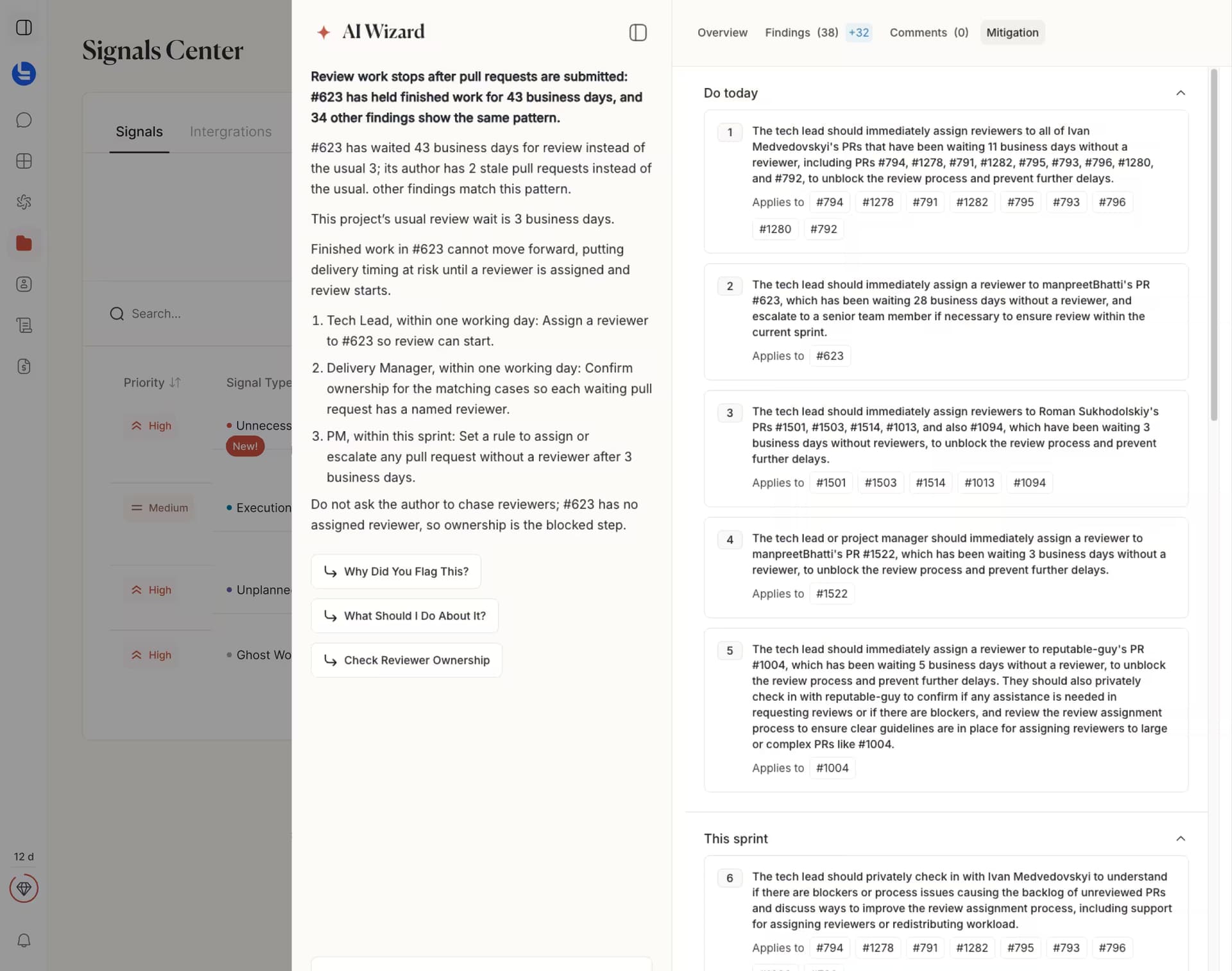
As AI project risk management software, Tolmete surfaces delivery drift while it is still manageable: stalled progress, unclear ownership, repeated rework, or added scope.
Directed to: Project Manager
Delivery risk root cause analysis connects each alert to evidence: scope movement, review delays, weak estimates, or repeated rework.
Directed to: Project Manager
Require new review requirements to become separate tickets instead of expanding the current PR.
Directed to: Bob Wilson, Tech Lead
When Tolmete names a person in a mitigation plan, it does so to move the issue forward, not to assign fault. The plan focuses on the blocker, the process, and the next decision, so managers can support the team while protecting delivery and client trust.
How it works
As a tool for AI risk detection and mitigation, Tolmete reduces the time managers spend reconstructing what happened across tickets, commits, reviews, messages, and status updates. Instead of starting with an investigation, they receive the root cause, the recommended action, the owner, and the timing.
Root cause, ownership, and next steps in one plan, so managers spend less time investigating and more time leading the team.
Earlier escalation with context and priority, so leaders know which risks require attention before the project is affected.
Portfolio-level visibility into project delivery risks. Every alert creates a decision trail, recording warnings and actions.
Clearer explanations when timelines change, backed by evidence instead of vague updates or reactive explanations.
In Conclusion
As a tool for AI risk detection and mitigation, Tolmete reduces the time managers spend reconstructing what happened across tickets, commits, reviews, messages, and status updates. Instead of starting with an investigation, they receive the root cause, the recommended action, the owner, and the timing.
On a fixed-price project, the plan may recommend filing a change request, quantifying unrecovered scope, and protecting margin.
Fixed-price Risk
Unplanned scope is being absorbed silently.
On a time-and-materials project, the plan may focus on transparent client communication, updated forecasts, and expectation management.
Tolmete Action
File a change request, quantify margin impact, and pause new scope until it is approved.
Tolmete helps agencies detect risks, understand root causes, and generate precise mitigation plans that specify what to do, who should own it, and when action is needed.
FAQ
Everything you need to know about Tolmete.