

Use Case · Reporting

Replace status reports with evidence

Fewer billing disputes, lower client churn: how agencies back every invoice with a clear record of the work.

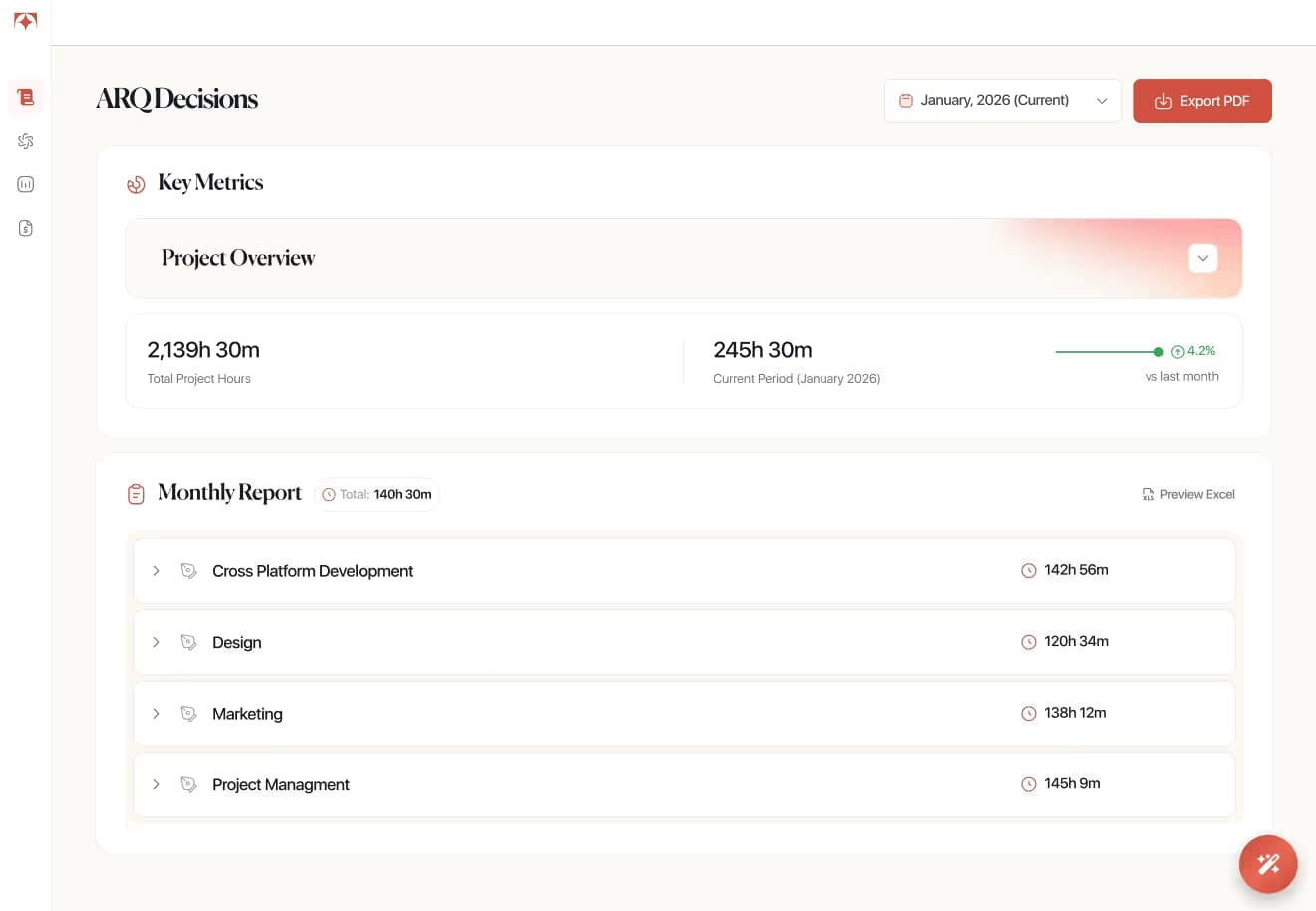
Tolmete margin protection preview — signals center surfacing budget drift on fixed-price projects

The report nobody reads takes all Friday to write

It is 6:47 PM on the last Friday of the month, and the PM is still working through the client update. There is no delivery crisis; the sprint is moving, and the client will still receive something on Monday. The reason she is staying late is more familiar: the status report has become a second project layered on top of the real one.

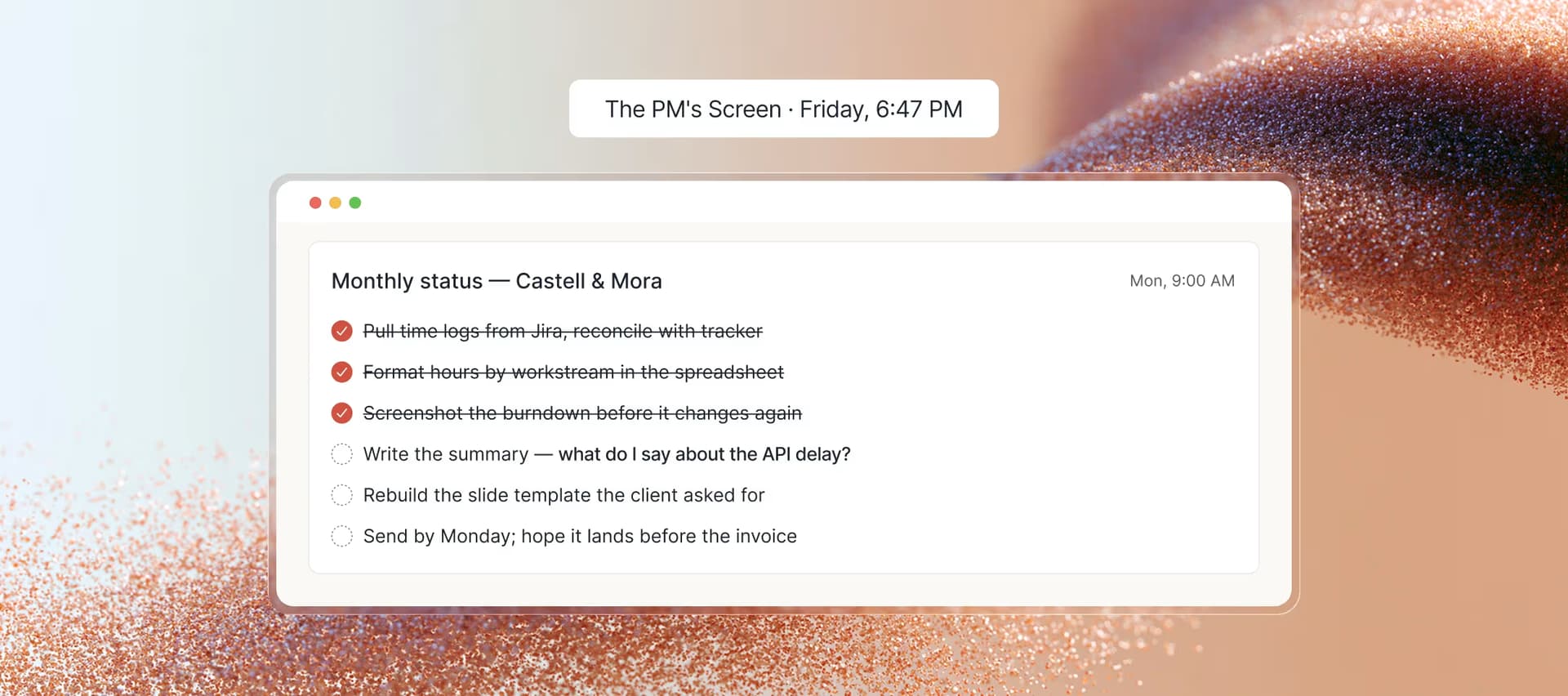
To prepare it, she pulls time logs from Jira, checks them against the tracker, formats hours by workstream, takes screenshots of the burndown before it changes again, reviews Slack context, and tries to explain the API delay clearly enough that it will not raise more questions. The work is careful and professional, but it is still reconstruction after the fact.

The PM's screen, Friday 6:47 PM — a monthly status checklist with three tasks done and three still open, including writing the summary and explaining the API delay

Six hours, give or take, this month and every month, multiplied by every active client. The result is a polished snapshot of the project: accurate for a short moment, already aging by the time it is sent, and separated from the live project records that could answer the next question.

The gap is the real reporting problem. The sections nobody asked for may go unread, while the one number a stakeholder checks can still raise a question the deck cannot answer. The PM then ends up back in the same Jira logs, time records, and Slack context that the report was supposed to clarify.

By Monday, the report is already behind the project

The manual status report fails in three ways at once, and working harder on the document does not fix the underlying issue. It is handwritten, frozen in time, and filtered through the person preparing it. That makes it expensive to produce and a limited source of client confidence.

It takes the PM's Friday every month

A status report may look like a document, but in practice it becomes a recurring delivery tax. The PM collects logs, reconciles hours, checks charts, writes the narrative, formats the deck, and reviews the tone before anything can be shared. Across several active clients, that 5–7-hour cycle represents a meaningful amount of senior delivery time spent on work that has already been recorded elsewhere.

It is outdated when it arrives

A report describes what happened during the previous period, while delivery decisions are already happening in the current one. By the time the client opens the attachment, the sprint may have moved, blockers may have changed, and the most useful context may already be elsewhere. Client uncertainty grows in that gap between a static report and the project as it actually stands today.

It depends too much on the writer

Without evidence to back up the update, the report depends on who writes it. One PM may share too much detail, another may protect the client from context they actually need, and a third may spend too much time managing tone. The client can sense when they are reading a carefully prepared narrative rather than a current, verifiable record of the work.

The hidden cost of manual reporting

The status report is the most expensive document nobody reads

5–7 h

Per project, per month, spent assembling manual status reports

Tolmete customer baseline

12 d

Earlier risk visibility compared with report-based tracking

Tolmete customer baseline

1 link

The private portal link the PM shares after review, instead of a new status deck every month

Tolmete platform data

Stop writing about the work. Let the work speak

The usual answer is to make reporting more disciplined: better templates, tighter update cycles, clearer status sections, and more consistent stakeholder notes. In practice, that still leaves the PM rebuilding project context by hand after the work has already happened.

Tolmete changes where the client update comes from. It works from the records your team already creates during delivery: approved time logs, closed tickets, task movement, delivery activity, blocker records, review progress, and PM-approved signals. Those records serve as the basis for a client-ready digest that explains what happened without requiring the PM to reconstruct the story from scratch.

The digest gives the client a clear view of what was done, where effort went, which updates matter, and what context has been approved for sharing. The PM still reviews the digest and decides which signals become visible, but the evidence no longer has to be collected manually from five different places every month.

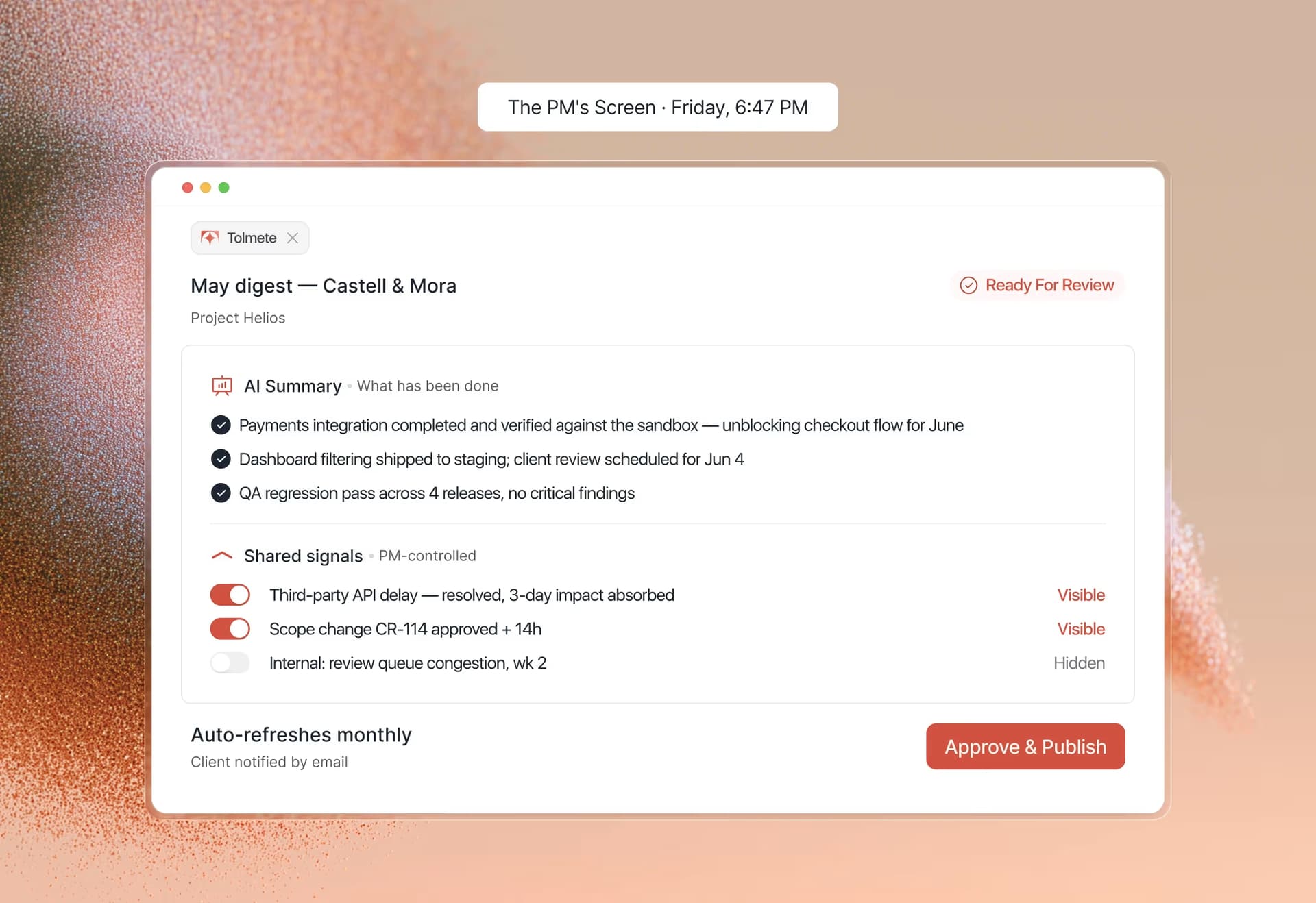
The PM's screen, Friday 6:47 PM — the May digest for Castell & Mora with an AI summary, PM-controlled shared signals, and an Approve & Publish button

The toggles matter because transparency should never mean giving the client an open window into the agency’s workspace. The resolved API delay can be shared because it helps the client understand delivery context. The internal review queue can stay private because it is operational detail, not client-facing value. The agency maintains control over what is shown, while the evidence makes the update easier to trust.

From project records to a client-ready digest

Tolmete does not add another reporting workflow. It builds the digest from the records the team already creates, keeps the core summary available in the client view, and gives the PM control over which delivery signals are shared with the client.

  1. Connect the project records

    Tolmete connects to the tools the team already uses: Jira, GitHub, Slack, time tracking, and other delivery systems. The team keeps working as usual, without writing a separate monthly report from scratch or maintaining another client-update workflow.

  2. Prepare the summary at three levels

    Tolmete prepares plain-language summaries at the project, team, and contributor level: what was worked on, what was completed, how long it took, and where the effort went. For a specific follow-up, the AI wizard can write a concise stakeholder update for a CEO, technical lead, or finance contact, ready to paste into an email or Slack.

  3. Let the PM choose which signals to share

    The PM controls which delivery signals appear in the client view. Internal signals and operational context remain within Tolmete, while client-relevant signals may be shared when they help explain changes in movement, risk, scope, or timeline. The summary stays available; signal visibility stays under PM control.

  4. Publish once and keep the view up to date

    The client gets one private link, with no login required. The digest refreshes on the agreed cadence and emails the client when a new update is available. If visibility needs to stop, the PM can unpublish the link and remove access immediately.

Traditional status reporting

  • Reports are built manually, month after month
  • Updates arrive as static files and email summaries
  • Clients see progress only when someone sends it
  • Already outdated by the time they arrive
  • Hours and activity are hard to verify
  • What gets shared depends on the writer
  • Questions arrive after uncertainty has built up

Evidence-based digest

  • Delivery evidence compiled automatically
  • One permanent link, refreshed every month
  • Clients return to the view and ask the AI wizard for context
  • AI summaries explain what was actually done
  • Time, activity, and contributor data attached
  • PMs control exactly which signals are shared
  • Visibility arrives before anyone has to ask

Controlled sharing

Choose which signals and details appear in the client view

Private workspace

Internal risks, blockers, and team discussions stay inside Tolmete

Client confidence

Clients can understand progress, costs, and value without having to turn every question into another email thread

Visible progress, private workspace

The natural objection is simple: agencies do not want clients inside their workspace, and they should not have to make that tradeoff. Client visibility only works when it is structured, limited, and controlled by the agency.

Tolmete’s client view is not the internal Projects page. Clients do not see team discussions, every delivery signal, internal blockers, or the full operational picture. The agency publishes a controlled external view, and everything else stays inside.

The Client Portal also includes an AI wizard for follow-up questions. When a client wants to understand a charge, an invoice change, budget status, or a delivery update, the wizard answers questions from the same approved records that underlie the digest: published time logs, AI summaries, activity breakdowns, and invoices. The client gets a direct, evidence-backed answer on the page itself, while the PM does not have to return to the logs every time a stakeholder asks for context.

Last manual report: the one you sent last month

Tolmete is designed to fit the tools your team already uses. Connect the stack, decide what becomes visible, and publish the client view once. From there, the digest stays current from approved project records, and PMs no longer have to produce the same report by hand every month.

The first digest is usually ready within a week. If a project needs more privacy later, unpublishing deactivates the link immediately, so the agency keeps control over what is shared and when access should stop.

Connect

(GitHub, Jira, Slack ~3 min per tool)

Choose

Pick what clients see

Publish

Private link + monthly refresh

The Friday evening the PM goes home on time

It is the end of the next month. The digest has already been prepared from the project records, and the PM is no longer building the entire update by hand. She spends twenty minutes reviewing the summary, adjusts two signal toggles, checks that the client-facing context is appropriate, and clicks publish.

The client receives the notification email at 5:04. By 5:15, the team is done for the day, and the Monday status call no longer needs to spend time walking through the previous month.

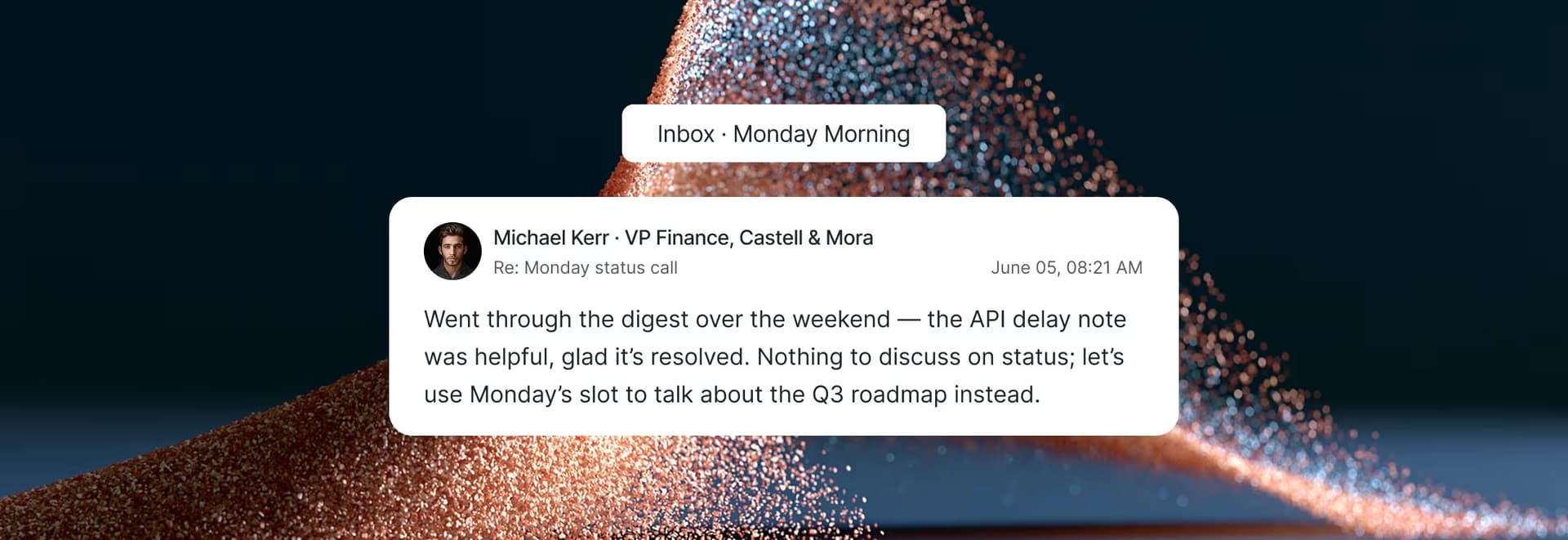
Inbox, Monday morning — a client reply saying the digest was helpful, the API delay is understood, and Monday's call can move to the roadmap instead

That is the real return. The 5–7 hours come back, but the larger shift is what fills the space the report used to occupy. The client arrives with a clearer record of what was built, the PM does not have to defend the update from memory, and the meeting time goes to planning instead of explaining.

A status report explains the work after someone rebuilds the story.

An evidence-based digest keeps the story current.

The old way

Without Tolmete

  • Collect logs and hours
  • Write and format the deck
  • Send Monday morning
  • Stale on arrival

5–7 hours per project, every month, for a snapshot that expires in days.

The Automated Way

With Tolmete

  • Digest prepared from records
  • PM reviews · 20 min
  • Approve and publish
  • Client reads it anytime

The status call becomes a roadmap call.

When clients can see the work, nobody asks for the report

Status reports exist because clients could not see the work, so someone had to describe it by hand every month. The report became a habit, even though the real need was always clearer visibility into progress, effort, and delivery context.

Tolmete changes where that context lives. Instead of asking the PM to write the update after the fact, it turns approved project records into a live client digest while delivery is still underway. The agency still decides what the client sees, but the evidence no longer has to be gathered by hand.

The result is a calmer client conversation: fewer status questions, fewer repeated explanations, and less time spent writing reports that existed only because the client had no better way to understand the work.

One digest.Twenty minutes of review. Fridays returned to their rightful owners.

Self-Serve

Start free in 7 minutes

Connect your tools and publish your first digest before this month's report is due.
No credit card, no demo call required.

  • Free for teams up to 7 people
  • All 5 signals included
  • Cancel anytime, no contract
Start Free Trial

Talk to Us

Get a custom walkthrough

For teams 25+ or with enterprise needs: dedicated SLA, SSO, custom integrations, and onboarding support.

  • 30-min product walkthrough
  • Sample digest built from your real data
  • Implementation roadmap

Tolmete helps IT service agencies connect project activity, approved time, delivery evidence, and client context, so clients can see the work they are paying for without having to ask PMs to rebuild the story by hand.