





1
Connect your tools
Tolmete connects to the systems where work already happens. You can start with basic time logs and add integrations later.
- — Jira
- — Git repositories
- — Calendars
- — Time logs
- — Communication tools
AI Decision Intelligence for service companies
Tolmete analyzes project activity from tickets, commit metadata, time logs, and connected calendar events. It links these signals to show where scope is expanding, delivery is slowing, or margin is beginning to erode.
Built for service teams across US, EU, and MENA
15%
Of project revenue typically leaks invisibly
$312k
Average annual margin lost by a 50-person service company (ARR ~2.5M USD)
$46k
Tolmete recovers in year one
6mo
Average Tolmete's payback time for the first year
The problem
They lose money because problems become visible too late. Small issues quietly turn into bigger problems:
Hours are being logged on the project, but there's no matching activity in the codebase or ticket tracker to account for them — leaving you with time on the invoice you can't explain. Tolmete flags the gap before it becomes a question your client asks first.
A client's "small addition" quietly becomes unplanned hours your team absorbs without a change request — and on a fixed-price contract, that's margin you won't recover. Tolmete catches the pattern as it forms, so you can raise the conversation with your client while there's still a window to act.
The same work is being written, discarded, and started over — spending budget without moving the project forward. Tolmete detects the pattern early so you can identify what's causing the loop and stop it before it eats into your margin.
Estimates keep missing by the same margin, sprint after sprint, which usually means the team is building against requirements that aren't solid enough to scope accurately. Tolmete surfaces the drift so you can resolve the ambiguity before it compounds into a delivery problem.
Time is being worked but not logged, which means your project data is always running behind reality — and the reports you're making decisions from are already out of date. Tolmete flags the gap so you can close it before it affects a client conversation or an invoice.
By the time these issues appear in reports, the budget is already gone.
At that point, the only option left is damage control — writing off hours, discounting invoices, or explaining delays to the client.
Tolmete changes this dynamic.
Instead of discovering problems at the end of the month,
you see them when there is still time to fix them.
What Tolmete Does
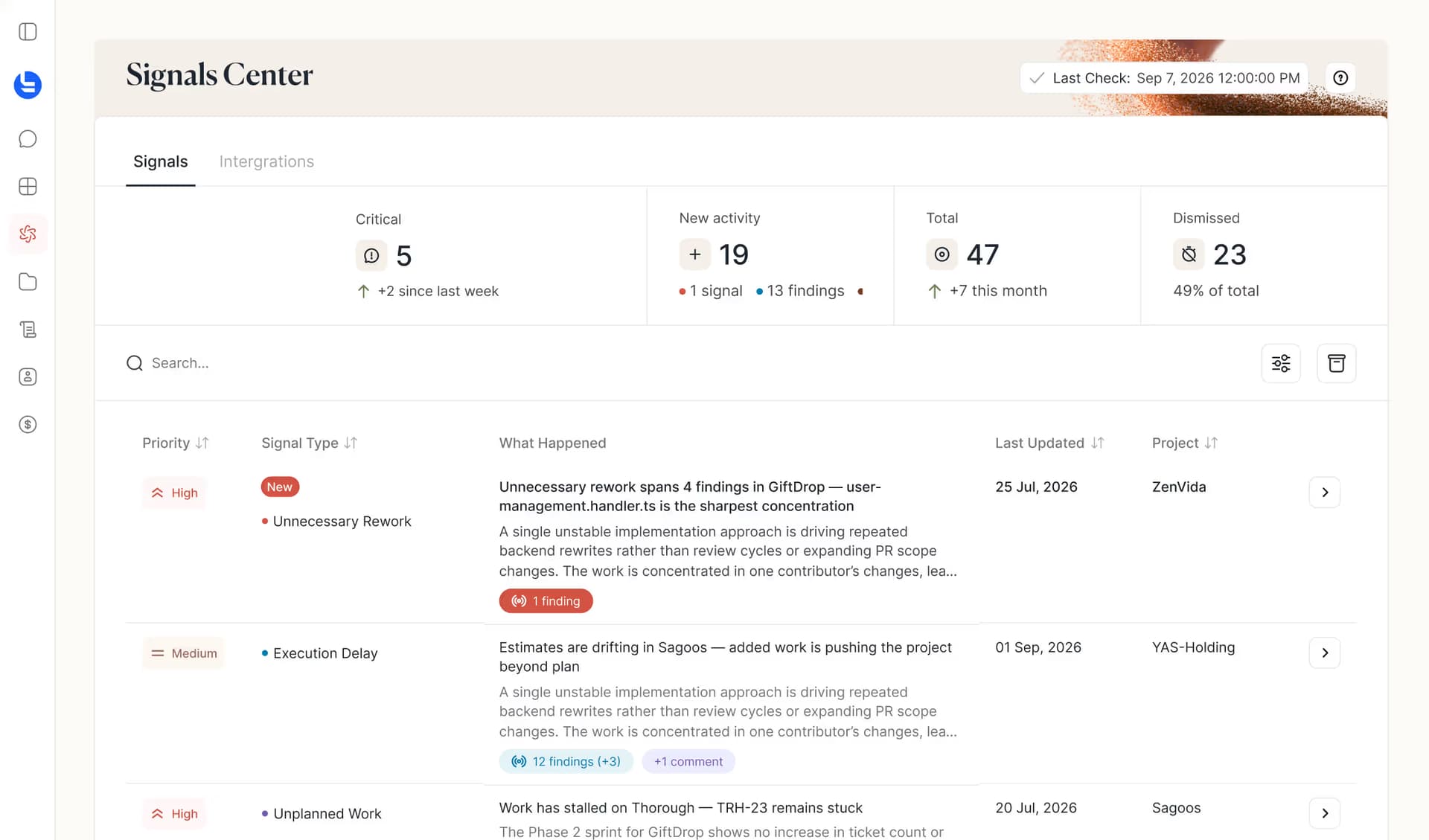
Tolmete continuously analyzes delivery signals across your projects and detects patterns that often lead to financial losses. Instead of passively recording time, it actively monitors how work actually happens.
See how Tolmete connects time, scope, budget, and delivery signals to reveal where profit is quietly slipping away — while there is still time to act.
What Tolmete Solves
If you recognize these patterns, you're not alone — they affect most service businesses. Tolmete catches them in real time, with dollar impact.
Your team is busy. Boards are full. Hours are logged. Yet at month-end, the P&L doesn't match the effort. Small leaks compound: quiet scope creep, hidden rework, and tasks taking 2–3× longer than estimated. None of it shows up on a Jira board.
Tolmete connects effort to real delivery signals and highlights exactly where time is actually going — while you still have time to act.
You see the sprint report on day 10. Completion is 45%. Budget is spent. You already know what comes next — the apologetic client call, the post-mortem, the write-offs. But the warning signs were there on day 3.
Tolmete continuously analyzes delivery signals and alerts you when something starts drifting — not a forensic report after the damage is done.
Every project eventually gets the request: “Can we also quickly add this?” A few weeks later, that small change is taking a big part of your team's week.
Tolmete detects scope expansion early and shows how much effort is spent on work that was never planned.
A project board can remain busy while delivery stalls. Tasks change status, commits continue, and updates accumulate, yet the project may make no meaningful progress for two weeks. The cost becomes visible when a task estimated at eight hours consumes 28.
Tolmete automatically links effort to artifacts and builds clear delivery narratives. Clients see what was done, how long it took, and why it mattered.
How Tolmete Works
Connect your tools once. Tolmete starts generating insights from day one and gets sharper as more signals flow in.
Tolmete connects to the systems where work already happens. You can start with basic time logs and add integrations later.
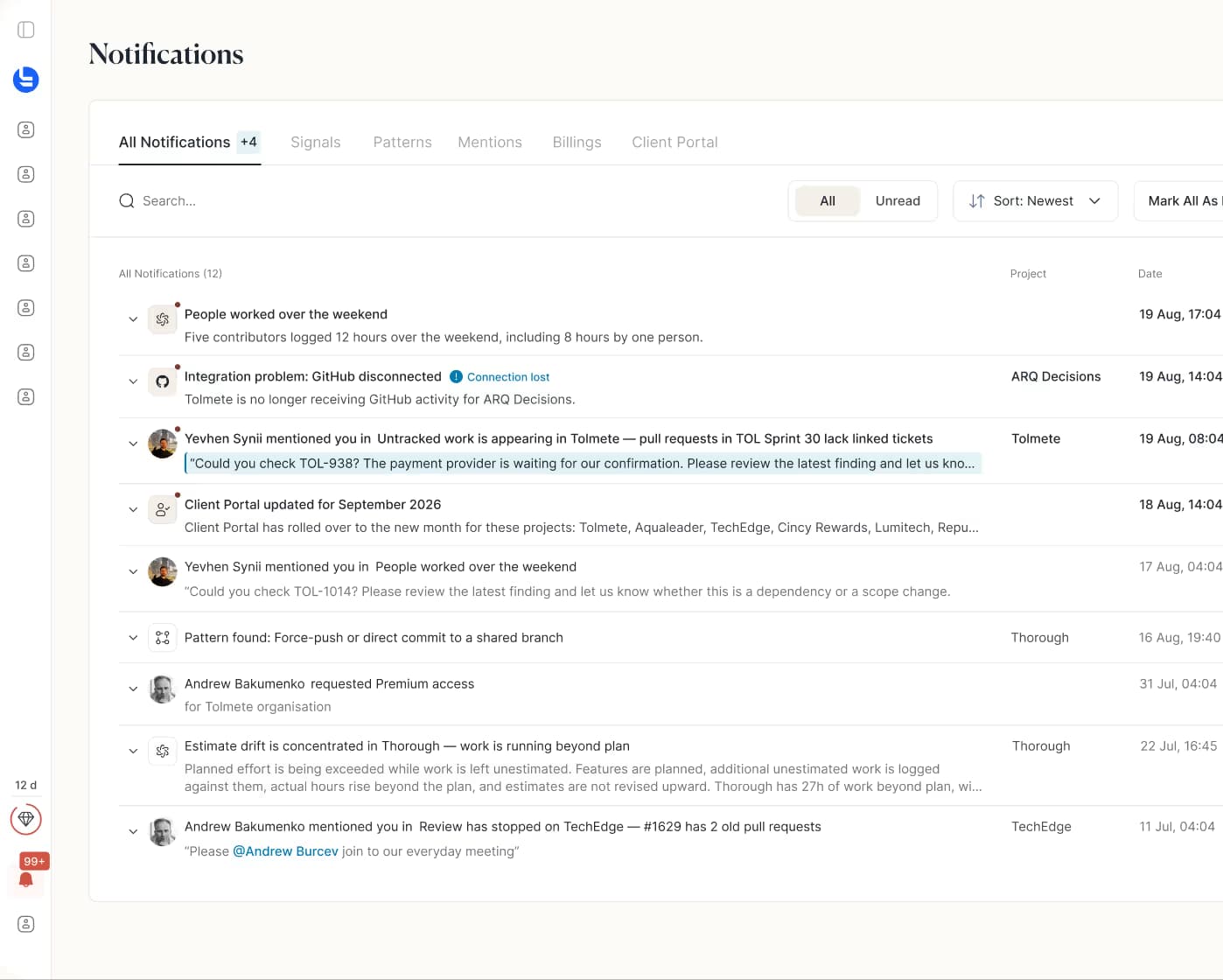
Tolmete compares patterns across tickets, commit metadata, time logs, connected calendar events, and other project activity. It turns those patterns into signals for task stagnation, rework, scope growth, and weak delivery evidence.
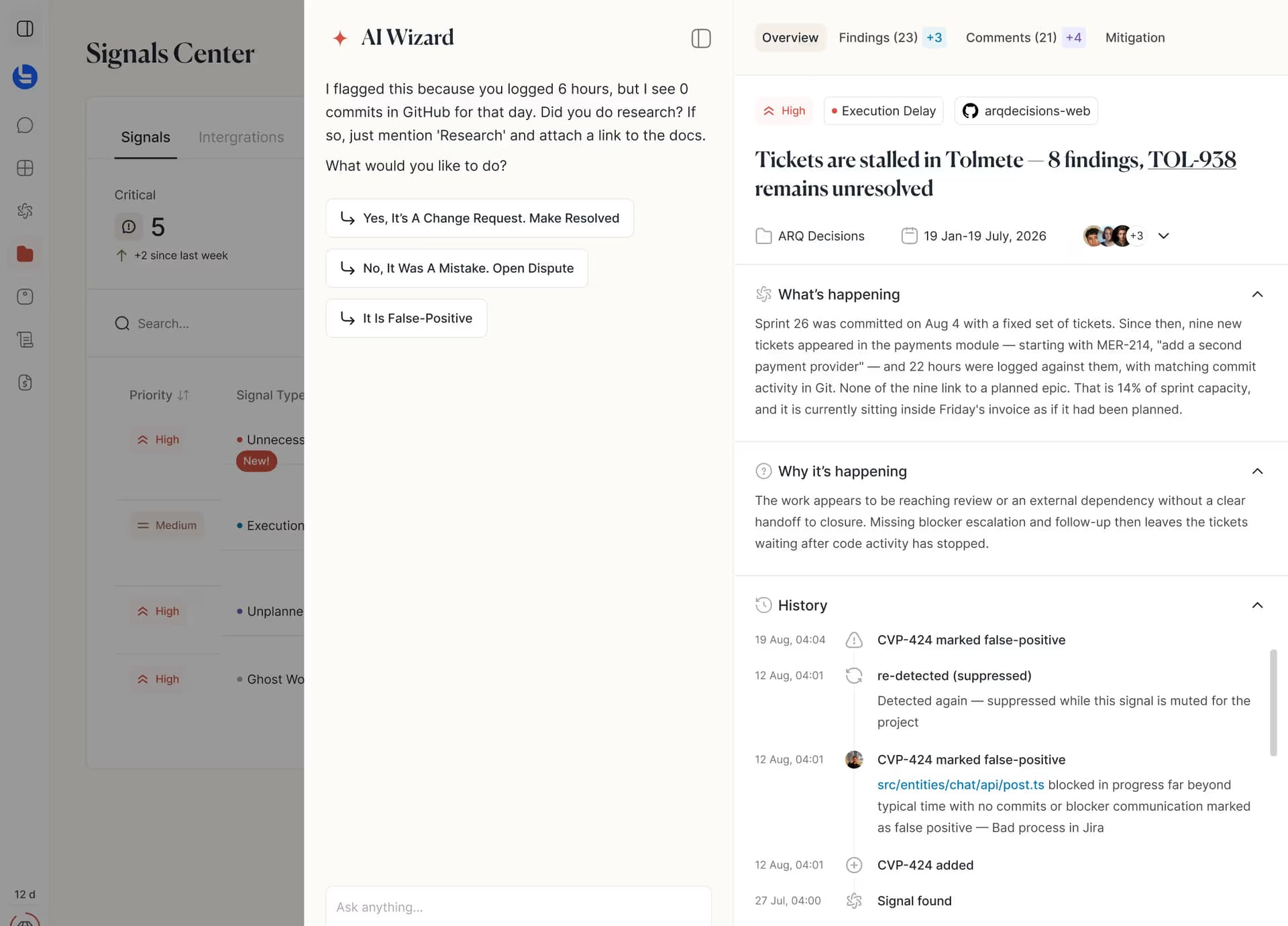
When Tolmete detects a risk, it tells you what it sees, why it matters, and suggests a mitigation plan. You stay in control — but never start from a blank page.
The signals we detect
Each signal triangulates data across time logs and your working tools. When something drifts, you see it with dollar impact and a suggested mitigation.
Unplanned Work
Work that never made it into the contract comes straight out of your margin — and it usually starts with a helpful "sure, we can add that."
New tickets that have no matching line in the signed scope and no change request, read against the project's billing model — flagged before the sprint closes, while there's still room to bill for the work or move it.
Execution Delay
A half-day task quietly becoming a week is how a client demo slips — without anyone deciding it should.
Time logged far past estimate on a critical-path task with no movement and no blocker raised — surfaced early enough to unblock, not after the deadline is already gone.
Unnecessary Rework
A team can look fully booked and still ship nothing — and you can end up paying three times for one feature.
The same module rewritten repeatedly with little net progress — a pattern in the work, surfaced without pointing at the person doing it.
Unverified Activity
When logged hours don't line up with delivery, the invoices and forecasts you hand a client are built on sand.
A gap between logged time and the delivery record, built only from metadata — commits, ticket transitions, time logs.
Knowledge Concentration
When one person is the only one who understands a critical system, their calendar quietly becomes your delivery risk.
Knowledge concentrated in one person on a business-critical module, read against upcoming leave and client commitments — so the risk surfaces before it becomes an outage.
Budgeting Accuracy
If your estimates are wrong the same way every sprint, every fixed-price bid you sign is underpriced before work even starts.
A consistent estimate-versus-actual gap by work type across sprints — the systemic pattern, not a single unlucky ticket — so you can correct pricing and forecasts instead of absorbing the difference.
Team Health
Losing your strongest developer to burnout is among the most expensive things that can happen to a project — and it builds silently, one quiet week at a time.
A sustained pattern across several signals — out-of-hours activity, falling output, slower communication, no time off — assembled from metadata and framed as a workload-distribution risk, never as monitoring an individual.
Ramp-Up Risk
A new hire who can't get productive is billable capacity you're paying for and not getting back — usually because of the setup, not the person.
A new joiner tracking well below the team's OWN onboarding baseline, with stalled review loops — measured against your history, not a generic benchmark.
The Shift
Most teams discover margin problems at quarter-end review.
Tolmete shows them while the project is still happening.
Without Tolmete
6-8 weeks
avg time to detect leak
18%
actual margin
With Tolmete
< 1 week
avg time to detect leak
23%
actual margin
The everyday tools — done right
Most teams discover margin problems at quarter-end review. Tolmete shows them while the project is still happening.
If your team is replacing Clockify or Harvest, you'll get a better daily tool — and an early warning system for free.
See It in ActionWho Tolmete Is For
Tolmete works for any service business that sells expertise and time — but it delivers the highest value to teams where margin erosion happens quietly across multiple projects.
You juggle complex, long-running projects where a “simple feature” can turn into three sprints of hidden work.Tolmete spots scope creep, rework, and stagnation long before you reach the demo that “suddenly” doesn’t fit the budget anymore. Connect Jira and Git, and the platform quietly checks if logged time matches real development activity. You stay on top of risks without micromanaging every commit.
Jira + Git + Slack
Your clients expect structured thinking, clear recommendations, and almost forensic transparency into how time was used.Tolmete acts like a neutral auditor of your delivery: it links consulting work to artifacts, tickets, workshops, and decisions. Instead of building manual decks and spreadsheets for every steering committee, you can pull a clear view of where the team’s brainpower went and what value it created.
Multi-engagement portfolio
You live in a world of urgent requests, revisions, and “can we try one more concept?”.Tolmete tracks how creative effort maps to client agreements, so you see when a campaign or design round quietly moves beyond what was sold. Reports stop being a list of billable hours and become a story of ideas, iterations, and impact — with enough proof to justify your invoices and change orders without drama.
Asana + Calendars
Your business runs on continuity: SLAs, recurring tasks, support queues, and distributed teams. It’s very easy to lose margin on invisible pieces of “just a quick fix” or on long-tail tickets nobody notices.Tolmete builds an activity stream from tickets, calls, and logs, then flags patterns where effort grows but outcomes don’t. You get early hints that a client, process, or queue needs to be re-priced, re-scoped, or re-designed.
SLA + ticket queues
You juggle complex, long-running projects where a “simple feature” can turn into three sprints of hidden work. Tolmete spots scope creep, rework, and stagnation long before you reach the demo that “suddenly” doesn’t fit the budget anymore. Connect Jira and Git, and the platform quietly checks if logged time matches real development activity. You stay on top of risks without micromanaging every commit.
Jira + Git + Slack
Your clients expect structured thinking, clear recommendations, and almost forensic transparency into how time was used. Tolmete acts like a neutral auditor of your delivery: it links consulting work to artifacts, tickets, workshops, and decisions. Instead of building manual decks and spreadsheets for every steering committee, you can pull a clear view of where the team’s brainpower went and what value it created.
Multi-engagement portfolio
You live in a world of urgent requests, revisions, and “can we try one more concept?”. Tolmete tracks how creative effort maps to client agreements, so you see when a campaign or design round quietly moves beyond what was sold. Reports stop being a list of billable hours and become a story of ideas, iterations, and impact — with enough proof to justify your invoices and change orders without drama.
Asana + Calendars
Your business runs on continuity: SLAs, recurring tasks, support queues, and distributed teams. It’s very easy to lose margin on invisible pieces of “just a quick fix” or on long-tail tickets nobody notices. Tolmete builds an activity stream from tickets, calls, and logs, then flags patterns where effort grows but outcomes don’t. You get early hints that a client, process, or queue needs to be re-priced, re-scoped, or re-designed.
SLA + ticket queues
You juggle complex, long-running projects where a “simple feature” can turn into three sprints of hidden work. Tolmete spots scope creep, rework, and stagnation long before you reach the demo that “suddenly” doesn’t fit the budget anymore. Connect Jira and Git, and the platform quietly checks if logged time matches real development activity. You stay on top of risks without micromanaging every commit.
Jira + Git + Slack
Your clients expect structured thinking, clear recommendations, and almost forensic transparency into how time was used. Tolmete acts like a neutral auditor of your delivery: it links consulting work to artifacts, tickets, workshops, and decisions. Instead of building manual decks and spreadsheets for every steering committee, you can pull a clear view of where the team’s brainpower went and what value it created.
Multi-engagement portfolio
You live in a world of urgent requests, revisions, and “can we try one more concept?”. Tolmete tracks how creative effort maps to client agreements, so you see when a campaign or design round quietly moves beyond what was sold. Reports stop being a list of billable hours and become a story of ideas, iterations, and impact — with enough proof to justify your invoices and change orders without drama.
Asana + Calendars
Your business runs on continuity: SLAs, recurring tasks, support queues, and distributed teams. It’s very easy to lose margin on invisible pieces of “just a quick fix” or on long-tail tickets nobody notices. Tolmete builds an activity stream from tickets, calls, and logs, then flags patterns where effort grows but outcomes don’t. You get early hints that a client, process, or queue needs to be re-priced, re-scoped, or re-designed.
SLA + ticket queues
Pricing Plans
Start free. Explore Tolmete with your team.
What You Have In Free
For growing dev shops ready to catch delivery risks before they reach the client.
Everything In Free, Plus
For mid-market service companies where delivery failure costs real margin and real client relationships.
Everything In Premium, Plus
Multi-team organizations with compliance needs.
Custom Price
Everything In Signature, Plus
Real ROI
$2.5M
revenue
35%
target margin
~9%
addressable margin leak
Three scenarios based on how aggressively you act on Tolmete signals
Conservative
2.4x
first-year ROI
Most Likely
3.8x
first-year ROI
Optimistic
5.3x
first-year ROI
Estimates based on industry benchmarks and typical service company economics. In most cases, Tolmete requires 6–10 weeks from onboarding to reach full signal accuracy. First measurable savings typically appear in month 2–3. Real outcomes depend on operational maturity. These are projections, not guarantees.
FAQ
Everything you need to know about Tolmete.