1
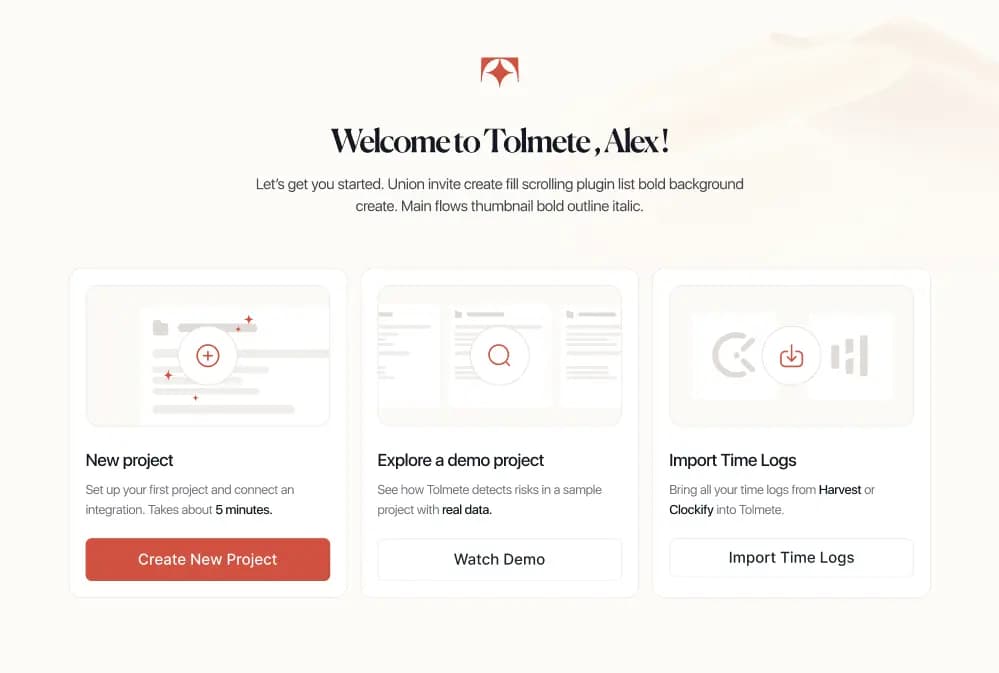
Create the project
Add only the essentials for real project setup: name, client, start date, and budget. No extra configuration, no custom fields jungle.
Training & Integration
Tolmete detects a real risk from your tools before onboarding ends. Your first insight isn't a tutorial — it's a finding.

The Problem
Most product onboarding flows end with a workspace, not with confidence. Teams complete setup, but still have no visibility, and no proof the product is working. Tolmete changes that by turning service team onboarding into the first monitoring moment.
Teams spend the first hour filling forms, naming projects, and clicking through steps. By the end, they still don’t see the system starting to really work for their goals which feels like more another admin overhead rather than a smarter workflow.
You log in and see a clean interface… with zero data. No risk, no insight, no context. For busy delivery leads, an empty dashboard during software project onboarding feels like “yet another tool that will take weeks to prove itself”.
Many tools postpone integrations until the very end or treat them as optional. Without real project data, there is nothing to analyze, so risk detection never really starts. Teams disconnect before the product has a chance to show value.
How It Works
When details are vague or data is invalid, Tolmete responds with precise guidance and examples so teams can move forward without breaking the workflow.
Add only the essentials for real project setup: name, client, start date, and budget. No extra configuration, no custom fields jungle.
Tolmete requests read-only access to GitHub, Jira, Asana, Slack, Google Calendar, or Linear. One integration is enough to start; you can extend the onboarding workflow later.
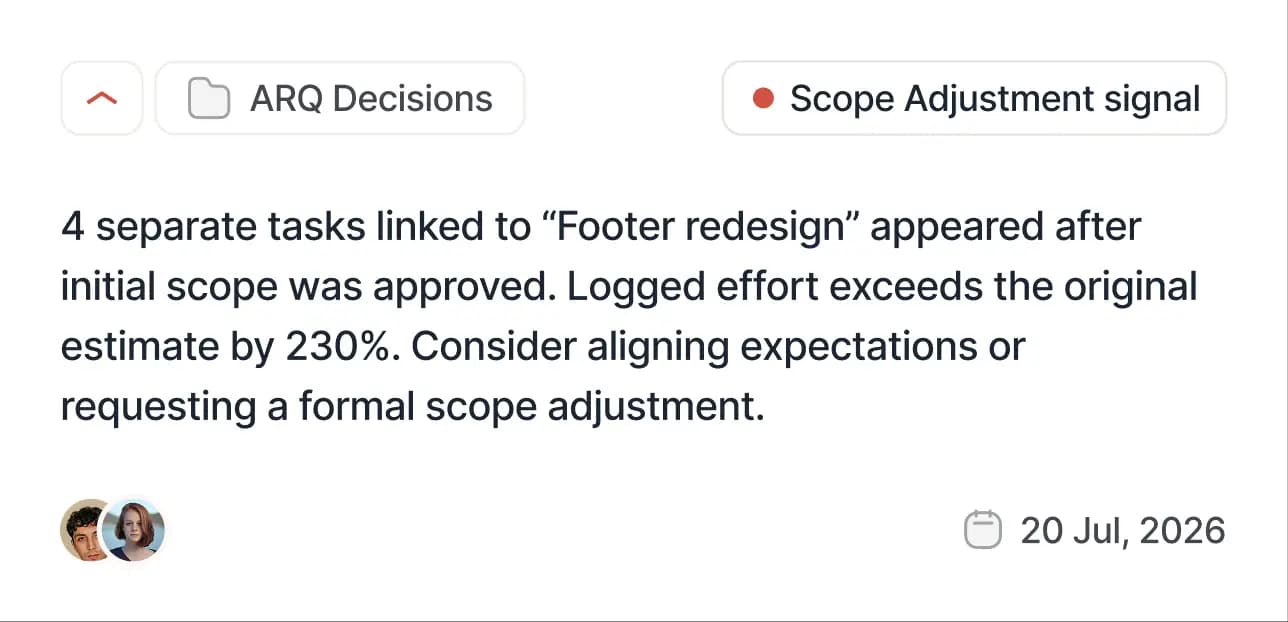
The system reviews historical patterns from your project data — tickets, commits, meetings. It looks for stagnation, rework, scope signals and weak delivery traces, using the same engine that powers production monitoring.
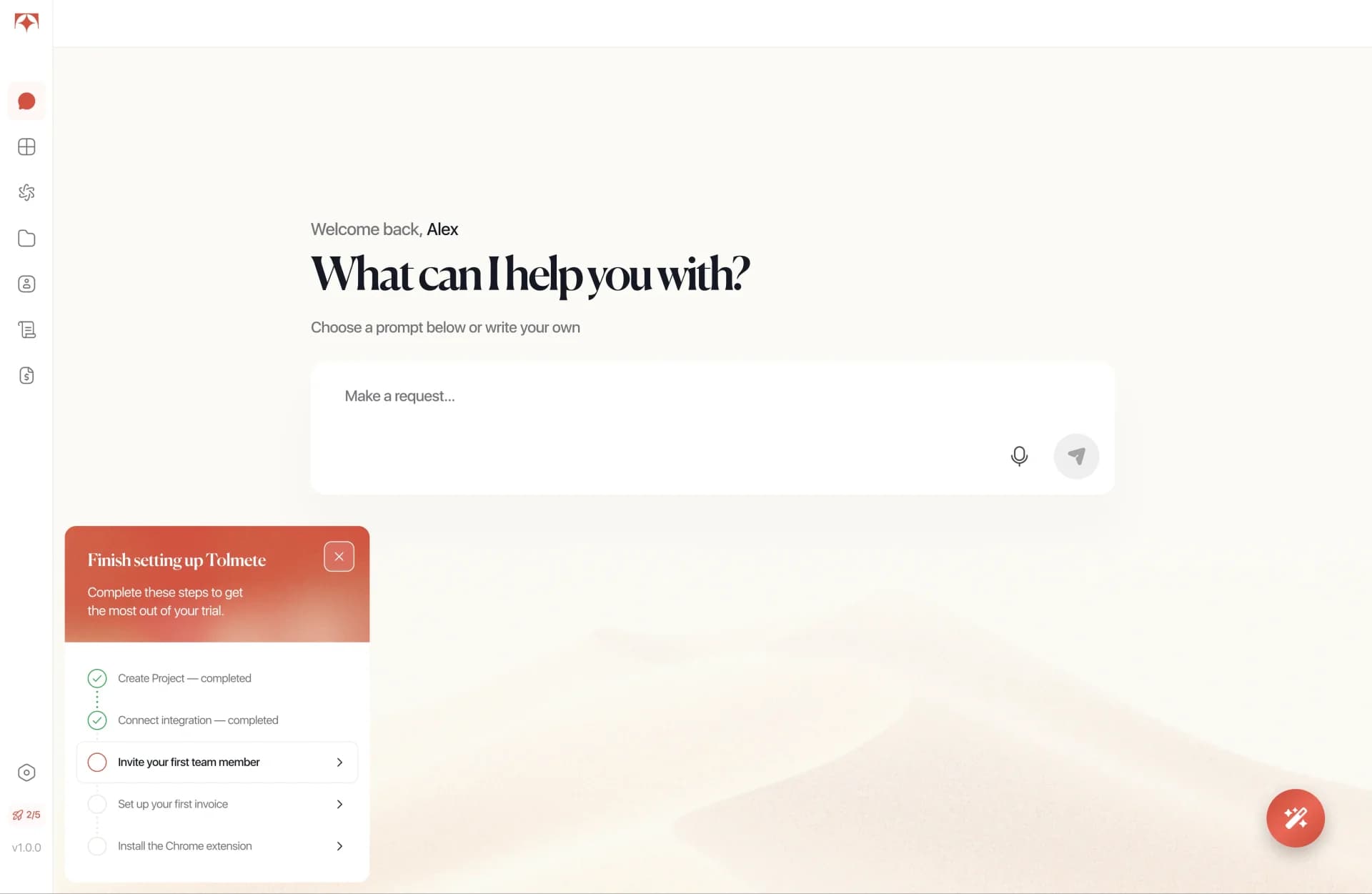
Instead of a blank dashboard, you see a risk pattern worth watching from day one. Your first experience of Tolmete is an actual insight, not a fake checklist.
No tutorials, no fake complexity — just a quick setup that takes teams hours, not weeks.
The Value
Tolmete is built around a simple principle: the first meaningful moment should happen inside project onboarding, not days later. If your repository or Jira history already shows a pattern, Tolmete surfaces it immediately.

Onboarding Without Noise
That is why the onboarding flow is intentionally lean:
For onboarding for CTOs, the signal is simple: connect one project, see one real risk, understand how it fits into architecture and process.
For onboarding for delivery teams and onboarding for service teams, it means: you can keep your current tools and habits; Tolmete will sit on top and observe.
Tolmete shows enough to build trust, then gets out of the way.
Simple, but Technical
Tolmete is not simulating progress. It uses project metadata, integration context, and historical activity to determine whether a risk pattern is already emerging. Under the hood, the same Universal Risk Sentinel that runs in production analyzes your unified activity stream during onboarding with real project data.
The result is a setup flow that feels lightweight to the user yet still reflects the real logic of delivery monitoring.
For onboarding for technical teams, it is important: there is a clear model behind the UI, not just demo data masked as “insight”.
Integrations are read-only and safe for technical teams
Classification logic relies on activity patterns, not hard-coded rules
Clarification Loop can ask administrators for context before labeling a risk
Faster Time to Value
Tolmete is designed as faster onboarding for real delivery work, not just account creation. For many agencies and tech companies, it quickly becomes the best onboarding workflow for agencies and internal service teams.
Only essential setup fields are required: project, client, budget, dates. Everything else can be configured later, so you reduce onboarding friction and keep momentum during evaluation.
The first signal appears during activation, not weeks later. Even a single integration can generate a tangible pattern to discuss in the next standup or steering call, making project onboarding feel immediately relevant.
From the first minutes, Tolmete frames the conversation around risks, margin, and scope — not just features. This helps delivery and finance teams align on what the tool is here to protect, and why it should stay in the stack.
Once you see value on one project, the same onboarding workflow repeats in minutes for others. This makes faster onboarding realistic even for large portfolios, without extra training sessions for every new client onboarding software roll-out.

Ready to Reach Value Faster?
Start with one real project and see how Tolmete reduces onboarding friction, surfaces risks, and helps your team understand where it fits before scaling across more workflows
FAQ
Everything you need to know about Tolmete.