


Use Case · Delivery Risk Mid-Sprint

Spot stuck work before the sprint review

Fewer sprint surprises, stronger delivery control: how agencies surface stuck work, rework, and blockers before the sprint review.

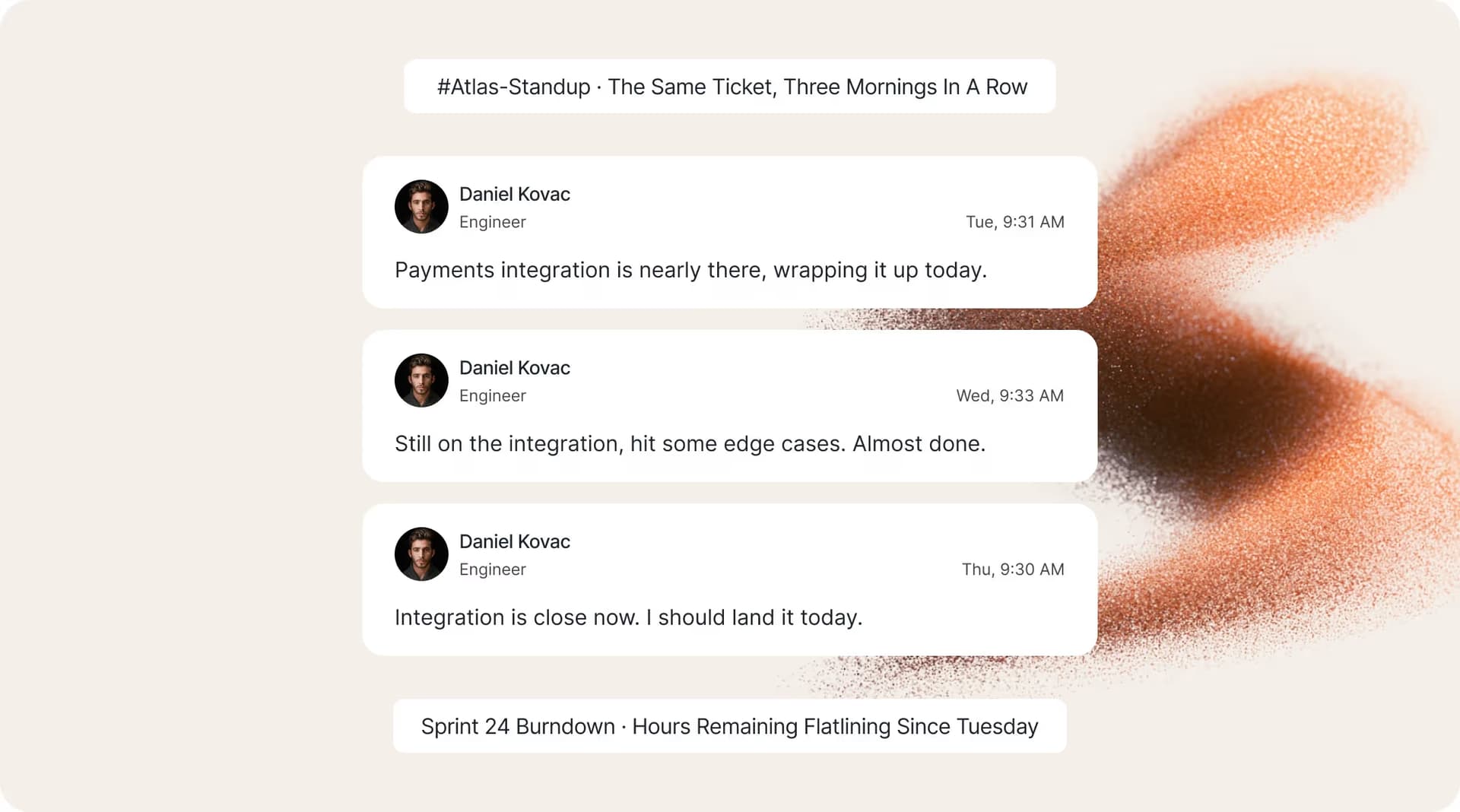
“Almost done” for three days, but the work hasn't moved

Every team runs standups to catch problems early. But when an engineer gets stuck, the standup rarely shows it: the update still sounds fine, the ticket still says "in progress", and the risk stays invisible until the sprint review.

#atlas-standup channel showing the same ticket reported as 'almost done' three mornings in a row, with the sprint burndown flatlining since Tuesday

Daniel is not hiding anything. He believes the status he is giving, because every engineer who has ever been stuck knows how close "almost done" can feel, and that is the real problem with self-reported status.

Meanwhile, the burndown has gone flat, the review queue is backing up behind the ticket, and two other tasks depend on it. None of this shows up in the standup, because a standup reports intentions, while the real state of the sprint lives in the activity around the work.

Status is a report. The activity is the pattern

Every invisible day turns a small unblock into sprint risk.

Stuck work still looks like progress

A blocked engineer still attends standup, still opens pull requests, still moves through the day. The pattern that shows the work has been circling the same problem for three days often exists only across task movement, review status, blocker records, and time spent.

Rework can look like movement

The same module rewritten three times still creates commits, reviews, comments, and activity. From a distance, the sprint looks active. Underneath, the team is spending hours without producing new delivery value.

The sprint review comes after the options are gone

The carryover becomes visible only after the sprint is already over. Tickets roll forward, the client demo becomes thinner, and the next sprint starts with debt. The options that were available on Tuesday are usually gone by Friday.

The hidden cost of mid-sprint delivery drift

Every invisible day turns a small unblock into sprint risk

3–4 d

Typical time an engineer stays stuck before escalating on their own

Tolmete customer baseline

12 d

Earlier risk detection compared with status-report-based tracking

Tolmete customer baseline

1 in 4

Sprint hours consumed by rework when churn goes undetected

Tolmete platform data

How Tolmete approaches this

See delivery risk while the sprint is underway

The usual answer is more process: longer standups, mid-sprint check-ins, and one more round of "any blockers?" In practice, that keeps depending on self-reporting, which is the part of the workflow that already misses the quiet risks.

Tolmete brings a clearer view into the sprint. It works from the project records your team already creates: task movement, pull request status, review queues, blocker records, time logs, ownership changes, and selected delivery context from connected tools.

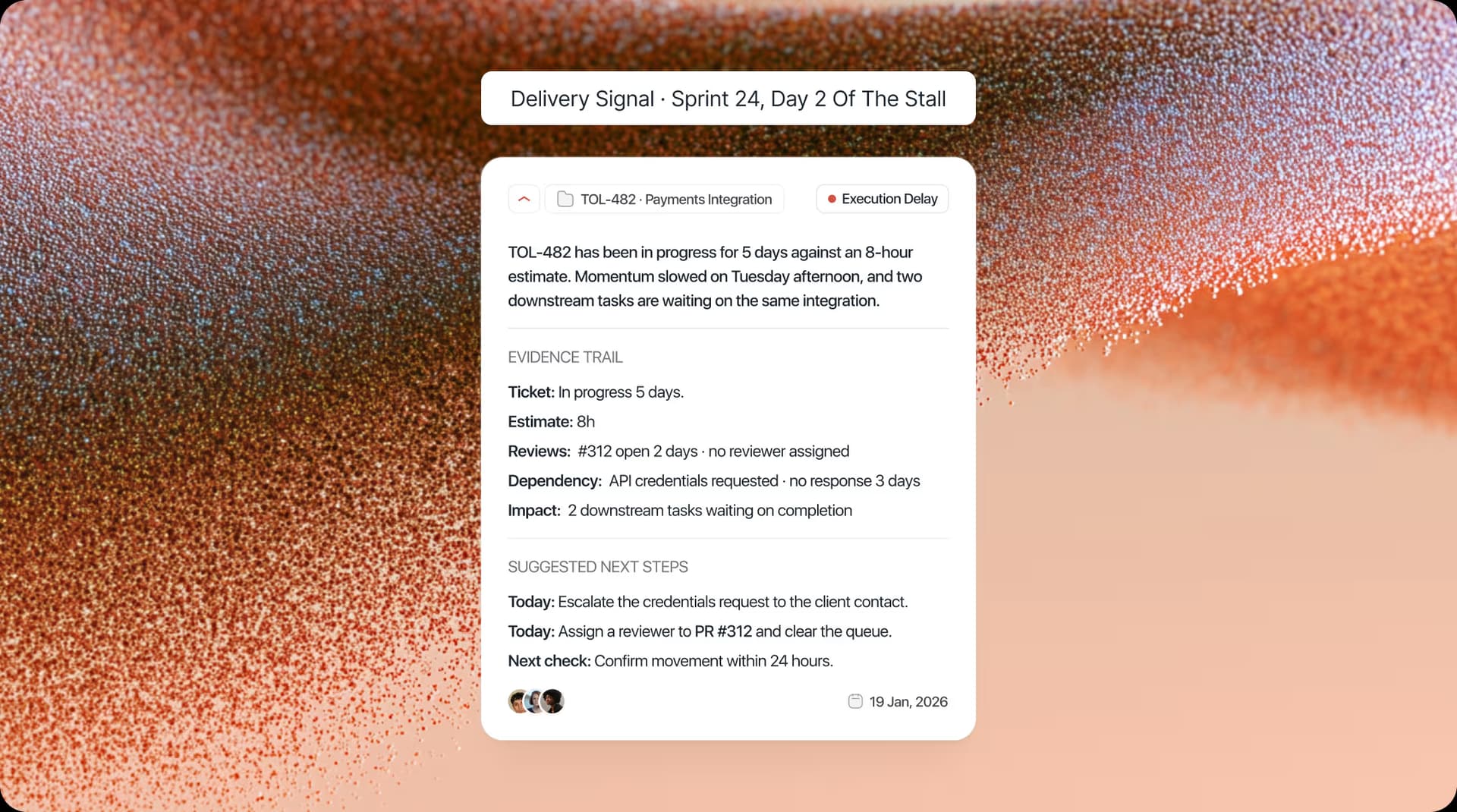
When work stalls, when the same code keeps being rewritten, when a review sits unanswered, or when a dependency blocks downstream tasks, Tolmete surfaces a signal with the evidence trail attached.

The PM can see what changed, why it matters, and what action can reduce risk while the sprint can still be adjusted.

Delivery signal for TOL-482, Sprint 24, day 2 of the stall: Execution Delay flagged with the evidence trail and suggested next steps

The signal never says "Daniel is slow." It points at the work: a stalled ticket, an unanswered dependency, an unassigned review, and the next action most likely to unblock the sprint. The engineer gets help, and nobody gets blamed.

From project activity to a signal the PM can act on

Tolmete does not add another layer of reporting to sprint delivery. It uses the records already created during the work to generate a clear signal when the pattern warrants PM attention.

  1. Connect the project records

    Tolmete connects the tools the team already uses: Jira, GitHub, Slack, time tracking, and other delivery systems. The team keeps working as usual, without adding another status workflow.

    Input: Tickets, pull requests, reviews, blockers, time logs

    Setup: ~3 min per tool

  2. Compare activity with the sprint plan

    Tolmete checks whether work is aligned with the sprint plan: task estimates, ownership, review flow, blocker status, dependency movement, and time spent. Normal activity stays part of the delivery picture. Activity that starts to drift contributes to a signal.

    Baseline: Sprint plan + estimates + ownership + dependencies

  3. Separate routine work from delivery risk

    Not every delay deserves interruption. Tolmete focuses on named patterns that usually precede sprint trouble: Execution Delay, High Code Churn, Onboarding Stall, Review Bottleneck, and Scope Creep. Each signal includes a confidence score, so the PM can focus on the risks that deserve action.

    Watched: Delivery risk patterns

    Filter: Confidence-scored signals

  4. Deliver a PM briefing with the evidence attached.

    Each signal shows what changed, when the pattern appeared, what evidence supports it, who is affected, and which action should happen next. The PM receives a focused briefing rather than another alert feed.

    Output: Signal + evidence trail + owner + next step

Support for the engineer, foresight for the PM

Tolmete does not add another layer of reporting to sprint delivery. It uses the records already created during the work to generate a clear signal when the pattern warrants PM attention.

The signal starts the conversation from the work itself: the PM can act earlier, the engineer gets support sooner, and a fixable delivery issue never turns into a personal performance discussion.

For agency leaders, that is also what keeps delivery risk away from the client: the problem is handled while it is still a sprint decision, not after it has affected the demo, the timeline, or the client’s confidence.

Delivery risk addressed before it reaches the client.

Better margin visibility across the client portfolio.

Project manager

Earlier escalation based on evidence, not standup tone.

Engineer

Help arrives sooner, without a reputation cost for being stuck.

Connected today.See your first signals this sprint

Tolmete is designed to fit the tools your team already uses. Connect your delivery stack, tune the sprint baseline, and start surfacing the patterns that usually hide between standups.

Signals point at work, not people. Every signal includes the evidence trail, confidence level, and next action for the PM to review.

Connect

Jira, GitHub, Slack, Time tracking · ~3 min per tool

Publish

Thresholds + Sprint cadence

Review signals

Evidence trail + Directed next step

The same standup, with the signal already in hand

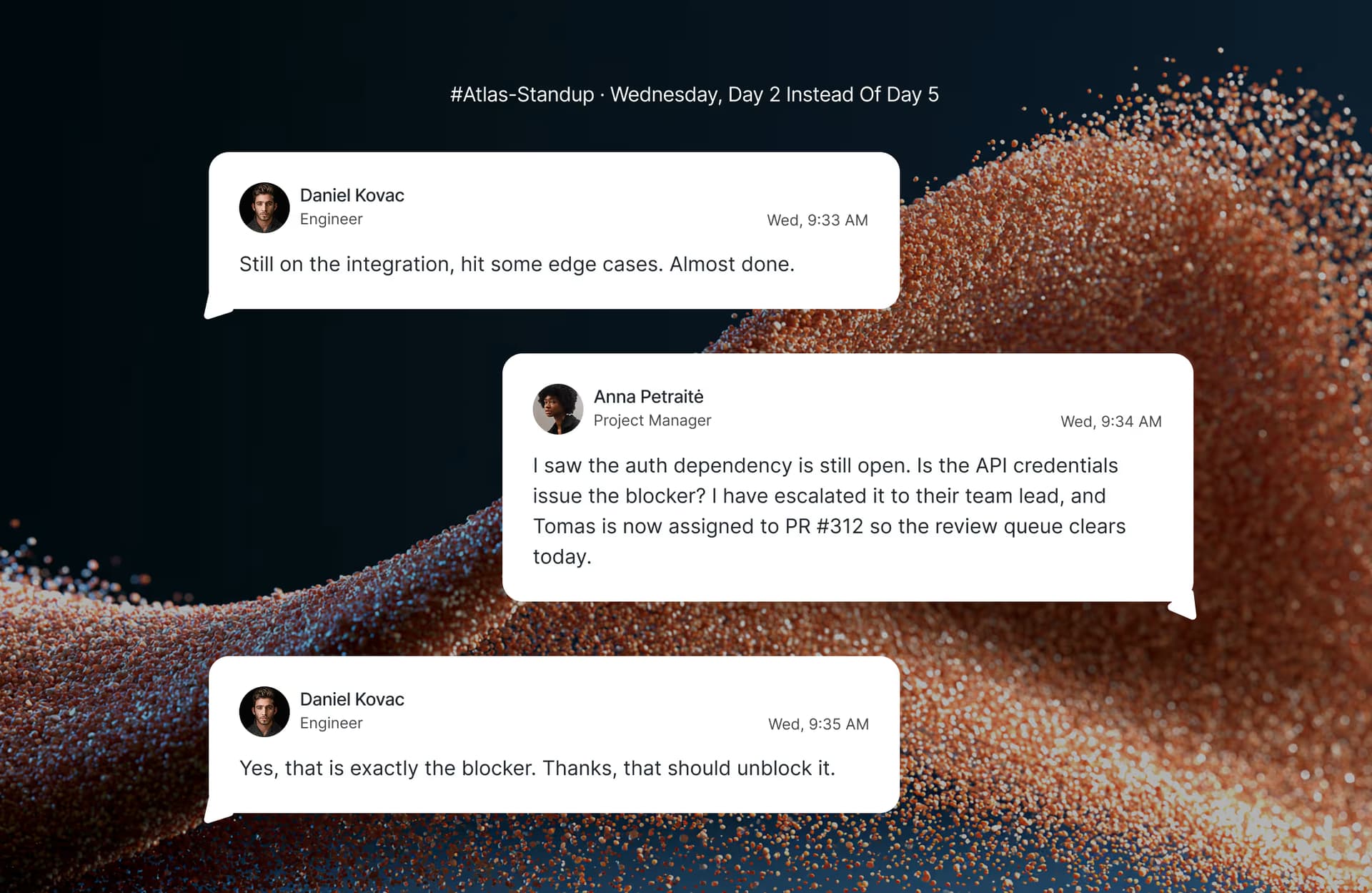
Back to Wednesday morning, in the same sprint, with the same stalled integration and the same engineer. This time the Execution Delay signal landed the evening before, with the unanswered dependency and the open review sitting in the evidence trail.

The standup goes differently because the PM is no longer relying solely on the report, even though Daniel says exactly what he said the day before.

#atlas-standup channel on Wednesday: the Execution Delay signal already flagged the dependency, so the PM asks a sharper question and the blocker clears the same day

The ticket lands Thursday. The two dependent tasks start on time, the demo stays full, and nothing rolls into the next sprint.

Three days of invisible stalled work never become a delivery surprise because the pattern surfaced while the sprint could still absorb the correction.

By the sprint review, the fix costs a week. Mid-sprint, it costs an hour.

The Manual Way

Without Tolmete

  • Work stuck on Tuesday
  • "Almost done" three days
  • Surprise at the review
  • Rolls into the next sprint

The blocker took one hour to resolve. Finding out about it took five days.

The Automated Way

With Tolmete

  • Work stuck on Tuesday
  • Flagged Tuesday evening
  • Blocker cleared Wednesday
  • Done by Thursday

Same blocker, same engineer, fewer invisible days.

The middle of the sprint stops being a blind spot

With delivery signals in place, the sprint stays visible from the first day to the demo. Problems get noticed when they are small, help reaches the engineer the same day, and the sprint review returns to being a demo of finished work.

For the team, that means calmer sprints and fewer surprises. For the agency, it means commitments that hold, sprint after sprint.

Surface delivery risk mid-sprint. Act while the fix is still small. Land what the team committed.

Self-Serve

Start free in 7 minutes

Connect Jira and GitHub, tuned to your projects within days.
No credit card, no demo call required.

  • Free for teams up to 7 people
  • All 5 signals included
  • Cancel anytime, no contract
Start Free Trial

Talk to Us

Get a custom walkthrough

For teams 25+ or with enterprise needs: dedicated SLA, SSO, custom integrations, and onboarding support.

  • 30-min product walkthrough
  • Custom ROI analysis for your team
  • Implementation roadmap

Tolmete helps IT service agencies connect project activity, approved time, delivery signals, and project context, so teams can surface risk while there is time to act.